Chemistry · Ch 9 — Amines
Reaction with Arylsulphonyl Chloride
Reaction with Arylsulphonyl Chloride
Reaction with Arylsulphonyl Chloride
Benzenesulphonyl chloride, , is commonly known as Hinsberg's reagent. It reacts with primary and secondary amines to form sulphonamides, and the way each class of amine behaves toward it — together with the very different solubility of the products in alkali — makes this reaction (the Hinsberg test) one of the standard laboratory methods for telling primary, secondary, and tertiary amines apart, and even for separating a mixture of the three.
Reaction with a Primary Amine
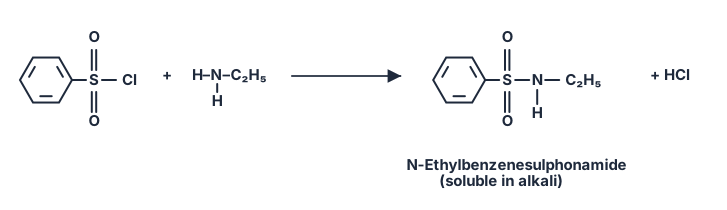
A primary amine reacts with benzenesulphonyl chloride to displace chloride and form an N-alkyl (or N-aryl) benzenesulphonamide, which still carries one hydrogen on nitrogen:
Drawn by us to help you understand the concept clearly, and verified to make sure it's accurate. For exams, practice from your textbook's own diagram.
Redrawn from the NCERT page with the structures, printed labels (Cl, –N, –C2H5, C2H5, + HCl) and reagent placement exactly as the textbook prints them. Every element of this display was checked against the printed page during the sweep's blind-judge verification pass, so w …
The product here, N-ethylbenzenesulphonamide, still has an N–H bond. Because that hydrogen sits directly on nitrogen next to the strongly electron-withdrawing sulphonyl group (), it is made distinctly acidic — the electron-withdrawing sulphonyl group pulls electron density away from nitrogen and stabilises the resulting anion once the proton is removed. As a result, this sulphonamide readily dissolves in aqueous alkali, forming a soluble potassium (or sodium) salt.
Reaction with a Secondary Amine
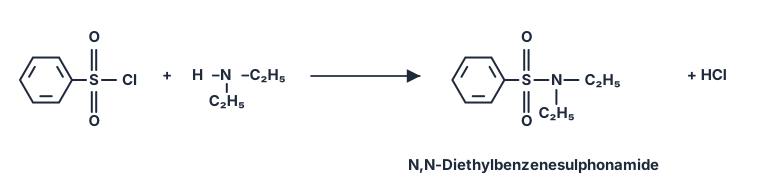
A secondary amine reacts the same way at first — nitrogen displaces the chloride of the sulphonyl chloride — but since a secondary amine only has one N–H hydrogen to begin with, that hydrogen is used up in bond formation and the product, an N,N-disubstituted benzenesulphonamide, is left with no hydrogen at all on nitrogen:
Drawn by us to help you understand the concept clearly, and verified to make sure it's accurate. For exams, practice from your textbook's own diagram.
Redrawn from the NCERT page with the structures, printed labels (Cl, –N, –C2H5, C2H5, + HCl) and reagent placement exactly as the textbook prints them. Every element of this display was checked against the printed page during the sweep's blind-judge verification pass, so w …
Since N,N-diethylbenzenesulphonamide has no acidic N–H hydrogen to ionise, it is not acidic, and consequently it does not dissolve in alkali — it remains insoluble.
Reaction with a Tertiary Amine
A tertiary amine has no hydrogen on nitrogen to begin with, so there is nothing for benzenesulphonyl chloride to substitute. Tertiary amines therefore simply do not react with benzenesulphonyl chloride at all, and on shaking with the reagent they are recovered essentially unchanged (and, being basic, will dissolve in the dilute acid used to work up the mixture, or separate out as an oily/insoluble layer depending on the amine, rather than forming any sulphonamide).
The Hinsberg test — solubility logic.
| Amine class | Reaction with | N–H left on product? | Behaviour in excess KOH |
|---|---|---|---|
| Primary | Forms N-substituted sulphonamide | Yes (one N–H) | Dissolves — the N–H is acidic (sulphonyl group withdraws electron density), so it ionises and forms a soluble salt |
| Secondary | Forms N,N-disubstituted sulphonamide | No | Insoluble — no acidic N–H left to ionise |
| Tertiary | Does not react at all | — (amine itself, unchanged) | Amine is simply recovered/separates out; no sulphonamide is formed |
| … |