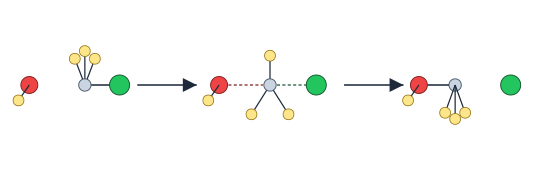
Q.Consider the following reaction (species labelled (a)–(e) as printed in the Exemplar):
In the printed diagram
Which of the following statements are correct about the reaction intermediate? (Two or more than two options may be correct.)
You're viewing a preview — the full solution, concept, methods & PYQ mapping are locked.
Start your 14-day free trial to unlock the full solution →
The reaction is an mechanism. The intermediate (c) is actually the transition state, not a stable intermediate. Carbon is bonded to five atoms and is hybridised in this trigonal-bipyramidal geometry. It is unstable because carbon cannot accommodate five full bonds, and it is less stable than the reactant. Therefore, statements (i) and (iv) are correct.
-
Identify the reaction type.
The species shown — attacking with inversion of configuration — is the classic bimolecular nucleophilic substitution (). In an reaction, bond formation and bond breaking occur simultaneously in a single step. There is no discrete intermediate that can be isolated; the species in square brackets (c) is the transition state, not a stable intermediate.
-
What is the geometry and hybridisation at carbon in (c)?
In the transition state, the carbon is partially bonded to five atoms: the three hydrogens (still in their original positions), the incoming group, and the leaving atom. This arrangement is trigonal bipyramidal.
For a trigonal-bipyramidal geometry, the central atom uses hybridisation for the three equatorial bonds (here, the C–H bonds) and the two axial positions (the incoming and leaving groups) involve orbitals. So carbon is hybridised in this transition state.
-
Evaluate each statement.
-
(i) Intermediate (c) is unstable because in this carbon is attached to 5 atoms.
This is correct. Carbon normally forms only four covalent bonds (octet rule). In the transition state, carbon has five partial bonds — it is pentacoordinate. This is a high-energy, unstable arrangement. The transition state cannot be isolated; it exists only fleetingly at the energy maximum of the reaction coordinate.
-
(ii) Intermediate (c) is unstable because carbon atom is hybridised.
This is incorrect in reasoning. hybridisation itself is not inherently unstable (e.g., in ethene, carbon is and perfectly stable). The instability here comes from pentacoordination, not from hybridisation. So the cause given is wrong.
-
(iii) Intermediate (c) is stable because carbon atom is hybridised. …
-
Unlock everything free for 14 days
- Full step-by-step solutions
- Concept-first explanations
- Methods, shortcuts & mistakes
- PYQ mapping + timed mock tests
Full access for 14 days. No credit card required.