Q.A water tank has the shape of an inverted right circular cone with its axis vertical and vertex lowermost. Its semi-vertical angle is . Water is poured into it at a constant rate of cubic metre per hour. Find the rate at which the level of the water is rising at the instant when the depth of water in the tank is m.
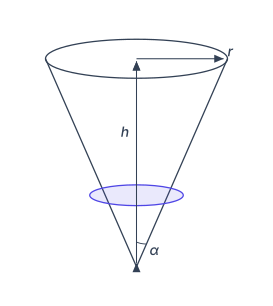
The key idea is to relate the volume of water in the cone to its depth using the geometry of the cone, then differentiate with respect to time. The rate at which the water level rises when the depth is 4 m is m/h.
This is a classic related rates problem. The core idea is simple: we know how fast the volume is changing ( m³/h), and we want to find how fast the depth is changing () at a specific moment. The bridge between these two rates is the geometric relationship between volume and depth for a cone.
The trick is that as water fills the cone, both the depth and the radius of the water's surface change together. But they aren't independent — the cone's fixed shape ties them together through the semi-vertical angle.
- Set up the geometry. The cone has a semi-vertical angle where . From the figure, , so:
This is the crucial relation — at any depth , the radius of the water surface is exactly half of .
- Write the volume in terms of only. The volume of a cone is . Substitute :
This expresses the volume of water entirely in terms of its depth — no separate needed.
- Differentiate with respect to time. Both and are functions of time . Differentiate both sides:
- Plug in the known values. We are given m³/h (constant), and we want when m:
- Solve for the rate.
A common mistake is to treat as constant when differentiating . But changes with ! Always eliminate (or ) using the cone's geometry before differentiating — otherwise you'll need the product rule and an extra relation.
Notice that the answer doesn't depend on the cone's full size — only on its shape (the semi-vertical angle). The rate is about 0.398 m/h, which makes sense: a wide, shallow cone (tan α = 0.5 means the radius grows slowly with depth) would have the water level rise relatively fast for a given inflow.
The rate at which the water level is rising when the depth is 4 m is .
Unlock everything free for 14 days
- Full step-by-step solutions
- Concept-first explanations
- Methods, shortcuts & mistakes
- PYQ mapping + timed mock tests
Full access for 14 days. No credit card required.