Q.A student of class XII studying Mathematics comes across an incomplete question in a book. Maximise 𝑍 = 3𝑥 + 2𝑦 + 1 Subject to the constraints 𝑥 ≥ 0, 𝑦 ≥ 0, 3𝑥 + 4𝑦 ≤ 12, He/ She notices the below shown graph for the said LPP problem, and finds that a constraint is missing in it: Help him/her choose the required constraint from the graph. The missing constraint is
(A) 𝑥 + 2𝑦 ≤ 2
(B) 2𝑥 + 𝑦 ≥ 2
(C) 2𝑥 + 𝑦 ≤ 2
(D) 𝑥 + 2𝑦 ≥ 2
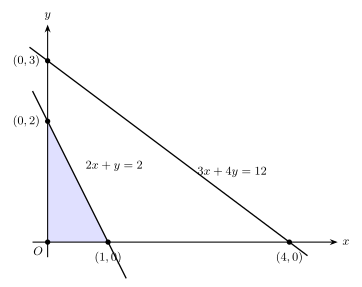
You're viewing a preview — the full solution, concept, methods & PYQ mapping are locked.
Start your 14-day free trial to unlock the full solution →The extra boundary runs through and , giving the line ; the origin satisfies it, so the missing constraint is — option (A).
The idea
Every constraint of an LPP is a straight line together with a choice of which side to keep. The stem already lists , and . The graph shows one more boundary that is not in this list — that hidden line is the missing constraint. To name it we (1) find its equation from its intercepts and (2) fix the inequality sign from the side on which the shaded region lies.
Step 1 — Equation of the fourth line
The fourth boundary meets the axes at and , so -intercept and -intercept . Using the intercept form :
Step 2 — Which side?
Test the origin , which lies inside the shown feasible region:
…
Unlock everything free for 14 days
- Full step-by-step solutions
- Concept-first explanations
- Methods, shortcuts & mistakes
- PYQ mapping + timed mock tests
Full access for 14 days. No credit card required.