Mathematics · Ch 11 — Three-Dimensional Geometry
Direction Cosines and Direction Ratios of a Line
Direction Cosines and Direction Ratios of a Line
Direction Angles and Direction Cosines
When a directed line passes through the origin and makes angles , , and with the positive , , and -axes respectively, these angles are the direction angles of the line. Their cosines — , , — are the direction cosines.
Reversing the direction of the line replaces each direction angle by its supplement (, , ). Since , all three direction cosines change sign.
A line can be extended in two opposite directions, giving two sets of direction cosines that differ only in sign. To obtain a unique set, treat the line as a directed line.
For a directed line, the unique direction cosines are denoted , , , where:
If the line does not pass through the origin, draw a line through the origin parallel to it. Parallel lines have the same direction cosines.
Direction Ratios
Any three numbers proportional to the direction cosines of a line are its direction ratios. If , , are direction cosines and , , are direction ratios, there exists a non-zero real number such that:
Direction ratios are not unique — any scalar multiple of a set of direction ratios is also a valid set.
Relation Between Direction Cosines and Direction Ratios
Since the two sets are proportional, write , so:
Using the fundamental identity and substituting (1):
Direction cosines from direction ratios
The sign is chosen depending on the desired orientation, and all three signs must be taken consistently.
A common mistake is to take different signs for different direction cosines. Since is a single constant, the sign must be the same for , , and .
Properties of Direction Ratios
›Proof
Property 1: If , , are direction ratios of a line, then so are , , for any non-zero .
With , , , we get , , . Since , these are proportional to , , , hence direction ratios of the same line.
›Proof
Property 2: Any two sets of direction ratios of a line are proportional.
…
Drawn by us to help you understand the concept clearly, and verified to make sure it's accurate. For exams, practice from your textbook's own diagram.
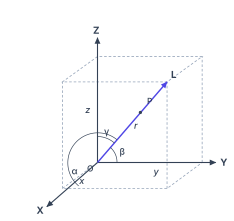
Figure 11.1 is the foundational picture for the entire chapter. It shows a single directed line segment starting at the origin and running into the first octant — the region where all three coordinates are positive. The line is drawn as an arrow, with the arrowhead at , to make it a directed line. The point lies somewhere on , and the length of is labelled .
The axes are drawn as an oblique 3‑D frame: is vertical, goes to the right, and comes out toward the lower left. From , dashed lines drop perpendicularly to each axis, meeting them at the coordinates , , . These three dashed edges, together with the axes, form a rectangular box (a cuboid) whose corner opposite is . The coordinates , , are simply the lengths of the sides of that box.
At the origin, three small arcs are drawn — one in each coordinate plane — marking the three direction angles , , . These are the angles that the directed line makes with the positive , , and axes respectively. The figure makes it visually clear that is the angle between and the -axis, between and the -axis, and between and the -axis.
The dashed cuboid is not just decoration. It shows that the coordinates , , of are the projections of onto the three axes. Because the box is rectangular, each coordinate is the adjacent side in a right triangle whose hypotenuse is .
From this single picture, the textbook derives the central relation between the direction cosines and the coordinates. In the right triangle formed by , , and the foot of the perpendicular from to the -axis, the adjacent side is and the hypotenuse is . So
These three cosines are called the direction cosines of the directed line , and they are denoted by , , :
Because , , are the sides of a rectangular box whose space diagonal is , Pythagoras in three dimensions gives . Dividing through by yields the fundamental identity
This identity is the single most important check for any set of direction cosines. If you ever have three numbers that claim to be direction cosines, their squares must add up to exactly 1.
The figure also sets up the idea of direction ratios. Any three numbers , , that are proportional to , , are called direction ratios of the line. From the geometry, , , can be taken as , , themselves (or any scalar multiple of them), because
So the coordinates of any point on the line (other than the origin) give a set of direction ratios. The constant of proportionality that connects direction ratios to direction cosines is
and the direction cosines are recovered as …