Physics · Ch 1 — Electric Charges and Fields
Coulomb's Law
Coulomb's Law
What is Coulomb’s Law?
Coulomb’s law is a quantitative statement that gives the electrostatic force between two point charges. A point charge is a charged body whose size is negligible compared to the distance separating it from other charges. The law was discovered experimentally by Charles-Augustin de Coulomb using a torsion balance.
The force between two point charges:
- Varies directly as the product of the magnitudes of the charges.
- Varies inversely as the square of the distance between them.
- Acts along the line joining the two charges.
How Coulomb arrived at the law
Coulomb used a torsion balance to measure the force between two charged metallic spheres. He did not know the exact amount of charge on each sphere initially. To vary the charge in a known way, he used a clever method:
- If a charged sphere (charge ) is touched to an identical uncharged sphere, the charge distributes equally, giving each sphere .
- Repeating this process yields charges , , etc.
By measuring the force for different separations (with fixed charges) and for different charge pairs (with fixed separation), he deduced the inverse-square law.
Mathematical form of Coulomb’s law
In vacuum, the magnitude of the electrostatic force between two point charges and separated by a distance is:
where is a proportionality constant. In SI units, the value of is chosen as:
Here, is the permittivity of free space, with value:
Thus, Coulomb’s law in SI units becomes:
This gives the magnitude of the force. The direction is along the line joining the charges — repulsive for like charges, attractive for unlike charges.
Vector form of Coulomb’s law
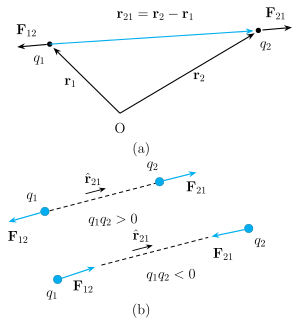
Let the position vectors of charges and be and . Define:
- (vector from to )
- (magnitude)
- Unit vector from to :
The force on due to is:
Similarly, the force on due to is:
This shows that Coulomb’s law obeys Newton’s third law: action and reaction are equal and opposite.
Important remarks
- The vector form works for any sign of and . If the product (like charges), is along (repulsion). If (unlike charges), is along (attraction).
- The law is valid for point charges in vacuum. In matter, the situation is more complex due to the presence of other charged particles.
- Coulomb’s law has been verified down to subatomic distances ( m).
Definition of the coulomb
The constant is chosen so that:
- If C and m, then N.
Thus, 1 coulomb is the charge that, when placed 1 m away from an equal charge in vacuum, experiences a repulsive force of N. This is a very large unit; in practice, smaller units like C ( C) or mC ( C) are used.
Comparison with gravitational force
Both Coulomb’s law and Newton’s law of gravitation have an inverse-square dependence on distance. However, the electrostatic force is enormously stronger than the gravitational force.
For an electron and a proton:
For two protons:
Inside a nucleus (distance m), the electrostatic force between two protons is about 230 N, while the gravitational force is only about N.
Example: Acceleration due to Coulomb force
For an electron and a proton separated by Å ( m):
- Magnitude of force: N
- Acceleration of electron: m/s² …
Drawn by us to help you understand the concept clearly, and verified to make sure it's accurate. For exams, practice from your textbook's own diagram.
What Figure 1.3 Shows
The figure is split into two panels, (a) and (b), that together illustrate the geometry and direction of Coulomb’s law.
Panel (a) sets up the coordinate system. An origin is drawn, with position vectors (pointing to charge ) and (pointing to charge , drawn higher up). The vector from to is labelled . Two force arrows are shown: (force on due to ) and (force on due to ). Both forces lie exactly along the line joining the charges — for like charges, they point away from each other, indicating repulsion.
Panel (b) shows two separate rows, each with a dashed line connecting and . Above each line is the unit vector .
- In the top row, the product (like charges): the force arrows point outward from each charge, away from the other.
- In the bottom row, (unlike charges): the force arrows point toward each charge, inward along the line.
The Physical Idea
The figure teaches that Coulomb’s force is always along the line joining the two charges, and its direction depends only on the sign of the product :
- Like charges () repel — forces point away from each other.
- Unlike charges () attract — forces point toward each other.
The vector notation and makes the direction mathematically precise: the force on due to is along for repulsion and along for attraction.
Key Formula Developed with This Figure
The textbook writes Coulomb’s law in vector form using the geometry of panel (a):
where:
- = force on charge due to (a vector),
- = permittivity of free space,
- = distance between the charges, …