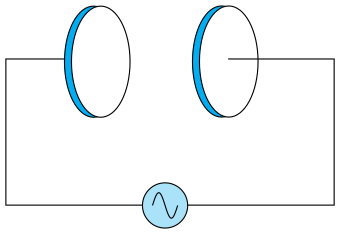
Q.A parallel plate capacitor (Fig. 8.6) made of circular plates each of radius R=6.0cm has a capacitance C=100pF. The capacitor is connected to a 230V ac supply with a (angular) frequency of 300rad s−1.
(a) What is the rms value of the conduction current?
(b) Is the conduction current equal to the displacement current?
(c) Determine the amplitude of B at a point 3.0cm from the axis between the plates.
Ampere's circuital law, in its original form, links the magnetic field around a closed loop to the conduction current (moving charges) threading that loop:
∮B⋅dl=μ0Ic
Maxwell realised this law is incomplete. The classic illustration is a charging capacitor. Consider an Amperian loop encircling the wire that feeds one plate.
If you cap that loop with a flat surface cut by the wire, a real conduction current Ic passes through it.
If you instead cap the SAME loop with a bulging surface that passes between the two capacitor plates, no charge crosses the gap — the space between the plates is an insulator. So Ic=0 through this surface.
Ampere's law now gives two different answers for ∮B⋅dl for the same loop, depending on which surface you choose. That is a contradiction — the law cannot be right as it stands.
Maxwell's Fix: A Current Made of Changing Field
Between the plates there is no moving charge, but there is a growing electric field, because charge is piling up on the plates. Maxwell proposed that a changing electric flux acts like a current for the purpose of producing a magnetic field. He called it the displacement current, Id.
Id=ε0dtdΦE
where ΦE=∫E⋅dA is the electric flux through the surface, and ε0=8.85×10⁻¹²C2N−1m−2 is the permittivity of free space.
Check with the capacitor. For a parallel-plate capacitor of area A and plate charge q, the field between the plates is E=ε0Aq, so the flux is ΦE=EA=ε0q. Then
Id=ε0dtdΦE=ε0⋅ε01dtdq=dtdq=Ic
So the displacement current in the gap is exactly equal to the conduction current in the wire. The two surfaces now give the same answer — the contradiction is gone.
The Complete (Ampere–Maxwell) Law
Maxwell rewrote Ampere's law so that the total current is conduction plus displacement current:
∮B⋅dl=μ0(Ic+Id)=μ0Ic+μ0ε0dtdΦE
Important
The deep meaning: a changing electric field produces a magnetic field, just as (by Faraday's law) a changing magnetic field produces an electric field. This symmetry is what makes self-sustaining electromagnetic waves possible — the changing E-field of the wave generates the B-field and vice versa.
Key Points to Remember
Displacement current is not a flow of charge; it is the effect of a time-varying electric flux.
It has the same units as ordinary current (ampere) and produces a magnetic field in exactly the same way.
It restores continuity of current: current is never truly broken, even across a capacitor gap.
Between capacitor plates Ic=0 but Id=0; in a plain resistive wire Id≈0 and Ic dominates.
Note
With this correction the four Maxwell equations become fully consistent and predict that electromagnetic disturbances travel at speed c=1/μ0ε0≈3×108m/s — the speed of light.
Bottom line: the displacement current Id=ε0dΦE/dt is Maxwell's term that lets a changing electric field act as a source of magnetic field, completing Ampere's law and opening the door to electromagnetic waves.
Displacement current, introduced by Maxwell to fix Ampere's circuital law, is a defining concept of the NCERT Class 12 Physics chapter on electromagnetic waves, tested in CBSE boards, JEE Main and NEET. Anyone searching "displacement current definition and formula class 12 physics" will find this capacitor-gap explanation matches the NCERT-prescribed derivation of the Ampere-Maxwell law.
Why this formula?
Displacement Current: Why the Formula Holds
The displacement current is one of the most elegant corrections in physics — it fixed a logical flaw in Maxwell's equations and predicted electromagnetic waves. Let's understand why its formula emerges.
1. The Problem That Demanded a Fix
Consider a capacitor being charged in a circuit. Ampère's law (in its original form) states:
∮B⋅dl=μ0Ienc
where Ienc is the current passing through any surface bounded by the loop.
Now take two different surfaces bounded by the same loop:
Surface S₁: Cuts the wire — current I passes through.
Surface S₂: Passes between the capacitor plates — no current passes through.
Surface
Current through it
S₁ (cuts wire)
I
S₂ (between plates)
0
This is a contradiction: the same loop gives two different values for ∮B⋅dl. Ampère's law is inconsistent for time-varying fields.
2. The Insight: Changing Electric Field
Between the capacitor plates, there is no conduction current, but there is a changing electric field as charge builds up.
The electric field between plates: E=ε0σ=ε0AQ
As Q changes, E changes: dtdE=ε0A1dtdQ
Maxwell realized: a changing electric field should produce a magnetic field, just like a current does.
3. Deriving the Displacement Current Formula
Step 1: Relate charge to electric flux
The electric flux through the capacitor plates is:
ΦE=∫E⋅dA=E⋅A=ε0Q
Step 2: Differentiate with respect to time
dtdΦE=ε01dtdQ=ε0I
Step 3: Define displacement current
Maxwell defined the displacement currentId as:
Id=ε0dtdΦE
From Step 2, this equals I — the same conduction current in the wire. The displacement current "bridges" the gap.
4. The Corrected Ampère-Maxwell Law
The full law becomes:
∮B⋅dl=μ0(Ienc+Id)
Or equivalently:
∮B⋅dl=μ0Ienc+μ0ε0dtdΦE
Why this works:
For surface S₁: Ienc=I, dtdΦE=0 → result = μ0I
For surface S₂: Ienc=0, dtdΦE=ε0I → result = μ0ε0⋅ε0I=μ0I
Both surfaces give the same answer. The contradiction is resolved.
5. The Key Formula(e) — Summarized
Quantity
Formula
Meaning
Displacement current
Id=ε0dtdΦE
Equivalent "current" from changing E-field
Ampère-Maxwell law
∮B⋅dl=μ0I+μ0ε0dtdΦE
Magnetic field from both real and displacement currents
In differential form
∇×B=μ0J+μ0ε0∂t∂E
Local version (for advanced study)
6. Why This Matters for Exams
Conceptual trap: Students often think displacement current is a real current of charges. It is not — it's a term that behaves like a current in producing magnetic fields.
Numerical problems: You'll often compute Id from dtdE or from the charging rate of a capacitor.
Key exam point: The displacement current is zero in steady-state DC circuits (constant fields), but non-zero in AC circuits or during charging/discharging.
7. The Deeper "Why"
The displacement current isn't just a mathematical patch — it reveals a profound symmetry:
A changing magnetic field produces an electric field (Faraday's law)
A changing electric field produces a magnetic field (Maxwell's correction)
This symmetry is what makes electromagnetic waves possible: each changing field sustains the other, allowing energy to propagate through empty space.
Final takeaway: The formula Id=ε0dtdΦE holds because it makes Ampère's law consistent for all surfaces and reveals the deep symmetry between electricity and magnetism.
XC=1/(ωC)=1/(300×100×10−12)≈3.33×107Ω, so Irms=230/(3.33×107)≈6.9μA. By Maxwell's continuity fix, the displacement current between the plates equals this conduction current at every instant. For r=3.0 cm <R=6.0 cm, the Ampere-Maxwell law on a circular loop gives B=μ0I0r/(2πR2), with peak current I0=2Irms≈9.76μA, giving B≈1.63×10⁻¹¹ T.
✓Final answer
Irms≈6.9μA.
Yes -- conduction current equals displacement current at every instant.
B≈1.63×10⁻¹¹T.
For this AC-driven parallel-plate capacitor, the rms conduction current is Irms=Vrms/XC≈6.9μA; by Maxwell's continuity argument the displacement current between the plates equals this conduction current at every instant; and applying the Ampere-Maxwell law to a circular loop of radius r=3.0 cm (inside the plates) gives a magnetic field amplitude B≈1.63×10⁻¹¹ T.
(a) RMS conduction current
The capacitor is driven by Vrms=230 V, angular frequency ω=300 rad/s, and C=100 pF =100×10−12 F. Its capacitive reactance is
XC=ωC1=300×100×10−121=3×10−81≈3.33×10⁷Ω
so
Irms=XCVrms=3.33×107230≈6.9×10⁻⁶A=6.9μA
(b) Conduction current vs. displacement current
Yes -- the displacement current between the plates equals the conduction current in the wires at every instant. This is exactly Maxwell's fix to Ampere's law: charge delivered by the conduction current in the wire builds up the changing electric field between the plates, and Id=ε0dΦE/dt=dq/dt=Ic, so current is continuous even across the insulating capacitor gap.
(c) Magnetic field amplitude at r=3.0 cm
Since r=3.0 cm <R=6.0 cm, the point lies inside the plate region, where only displacement current threads a circular Amperian loop of radius r. Because the field (and hence the displacement current density) is uniform across the plate area, the enclosed displacement current scales with area:
Id,enc=I0R2r2
where I0=2Irms=2×6.9×10−6≈9.76×10⁻⁶A is the peak current. Applying the Ampere-Maxwell law to the loop:
B⋅2πr=μ0I0R2r2⇒B=2πR2μ0I0r
Substituting μ0=4π×10−7 T*m/A, I0=9.76×10⁻⁶ A, r=0.03 m, R=0.06 m:
Yes -- the displacement current equals the conduction current at every instant.
B≈1.63×10⁻¹¹T.
Method: Magnetic Field Inside an AC-Driven Capacitor (Ampere–Maxwell Law with a Growing Enclosed Area)
Use this method whenever a question gives an AC-driven capacitor and asks for the magnetic field at a point between the plates, at some radius r less than the plate radius R.
Steps
Step 1: Find the (rms or peak) conduction current from the AC circuit
Treat the capacitor as an impedance XC=1/(ωC) and use an Ohm's-law-style relation:
Irms=XCVrms=VrmsωC
Convert to amplitude with I0=2Irms if the field amplitude (not rms value) is asked for.
Step 2: Confirm displacement current equals conduction current
As with any parallel-plate capacitor, Id=Ic at every instant — no conduction current crosses the gap, but the changing electric flux reproduces the same value.
Step 3: Apply the Ampere–Maxwell law to a loop of radius r<R
∮B⋅dl=μ0Id,enclosed
Because the field (and hence the displacement current density) between uniform circular plates is spread evenly over the plate area, a loop smaller than the plates encloses only a fraction of the total displacement current, proportional to the enclosed area:
Id,enclosed=IdπR2πr2
Step 4: Solve for B
B⋅2πr=μ0IdR2r2⟹B=2πR2μ0Idr
Substitute the current amplitude found in Step 1 to get the amplitude of B at the given radius.