Q.What are electromagnetic waves? Draw their propagation diagram. Show the electric field amplitude and magnetic field amplitude in propagation diagram.
🔒You're viewing a preview — the full solution, concept, methods & PYQ mapping are locked.
🔒 Start your 14-day free trial to unlock the full solution →Concept understanding — Characteristics of Electromagnetic Waves
Electromagnetic waves share a set of defining properties that follow directly from Maxwell's equations. They are transverse waves: the electric field E and magnetic field B are always mutually perpendicular, and both are perpendicular to the direction of propagation, with that direction itself given by the cross product E×B (which also represents the energy flow of the wave). The two fields vary sinusoidally in phase, reaching their maxima and minima together, and they need no material medium -- EM waves travel through vacuum as readily as through solids, liquids or gases, obeying the principle of superposition like any other wave. …
Electromagnetic waves are transverse waves of mutually perpendicular, in-phase oscillating electric (E) and magnetic (B) fields, both perpendicular to the direction of propagation, travelling in vacuum at c=3×10⁸ m/s with E0/B0=c. …
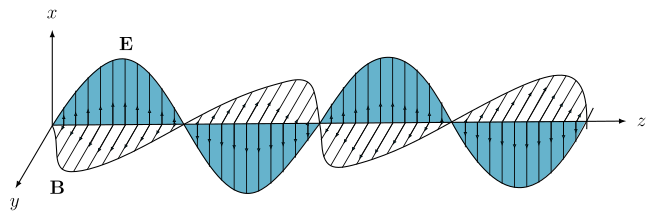
EM waves are transverse waves of perpendicular, in-phase E and B fields propagating at c; E0/B0=c.
What are electromagnetic waves? Electromagnetic waves are waves in which electric and magnetic fields oscillate. Key features:
- E and B are mutually perpendicular, and both are perpendicular to the direction of propagation — so EM waves are transverse.
- The two fields oscillate in phase (reach maxima and zeros together).
- They need no material medium and travel in vacuum with speed c=μ0ε01=3×10⁸ m/s.
- The amplitudes are related by B0E0=c.
Propagation diagram. For a wave travelling along the x-axis: the electric field E oscillates in the y-direction with amplitude E0, and the magnetic field B oscillates in the z-direction with amplitude B0.
   y
   |   E0
   |  /\        /\        (E oscillates along y)
   | /  \      /  \ …
Showing the 12 most recent of 29 on this concept.
- CBSE 2026Set A1 markMCQQ.Who first explained electromagnetic waves mathematically? (A) Einstein (B) Faraday (C) Maxwell (D) Hertz
›Reveal solutionSolution
Maxwell predicted EM waves theoretically (1865); Hertz confirmed them experimentally (1887).
James Clerk Maxwell unified electricity and magnetism into four equations and showed mathematically that a changing electric field produces a changing magnetic field and vice versa, propagating as an electromagnetic wave at speed c=1/μ0ε0 — equal to t …
- CBSE 2026Set ANNUAL1 markQ.Mention any one property of electromagnetic waves.
›Reveal solutionSolution
One key property: electromagnetic waves are transverse - E and B oscillate perpendicular to each other and to the direction the wave travels.
Electromagnetic waves consist of oscillating electric (E) and magnetic (B) fields that are mutually perpendicular, and both are perpendicular to the direction of propagation of the wave - making them transverse waves. Other valid properties (any one suffices to answer): they do not require a material medium and can travel through vacuum; they all travel at the same speed in vacuum, c = 3 x 10^8 m/s; they carry energy and momentum …
- CBSE 2026Set ANNUAL1 markMCQQ.Electromagnetic waves are produced by:(a) Charge at rest(b) Charge in uniform motion(c) Accelerated charge(d) None of the above
›Reveal solutionSolution
Electromagnetic waves are radiated only by charges that are accelerating (changing velocity).
A charge at rest produces only a static electric field; a charge in uniform motion produces steady electric and magnetic fields but radiates no wave. Only when a charge accelerates do its associated electric and magnetic fields change with time in a way that detaches from the charge and propagates outward as a self-sustaining ele …
- CBSE 2025Set IMPROVEMENT1 markMCQQ.Electromagnetic waves are produced:(a) By static charge(b) By uniformly moving charge(c) By accelerated charge(d) By neutral particles
›Reveal solutionSolution
Electromagnetic waves are radiated only by charges that are accelerating (oscillating charges being a common example).
A charge at rest produces only a static electric field, and a charge moving with uniform velocity produces steady electric and magnetic fields, but neither radiates energy as an electromagnetic wave. Only an accelerated charge — one whose velocity is changing (e.g. an oscillating charge) — produces a time-varying electric field, which in turn prod …
- CBSE 2025Set D1 markMCQQ.Which of the following is not an electromagnetic wave? (A) Alpha rays (B) Gamma rays (C) Infrared rays (D) X-rays
›Reveal solutionSolution
Gamma rays, infrared and X-rays are all EM waves; alpha rays are charged particles (He nuclei), so they are not EM waves.
Electromagnetic waves are oscillating electric and magnetic fields that travel at the speed of light and carry no charge or rest mass. Gamma rays, X-rays and infrared rays are all parts of the electromagnetic spectrum.
…
- CBSE 2025Set D1 markMCQQ.The speed of electromagnetic wave in any material medium does not depend (A) Upon its wavelength (B) Upon its frequency (C) Upon its intensity (D) Upon its permittivity
›Reveal solutionSolution
Wave speed in a medium is v = 1/√(με); it does not depend on how intense (bright) the wave is.
The speed of an electromagnetic wave in a material medium is
v = 1/√(μ ε) = c/n
where ε is the permittivity and μ the permeability of the medium. Because the refractive index n varies with frequency (dispersion), the speed does depend on frequency and hence wavelength, and clearly on permittivity.
…
- CBSE 2025Set ANNUAL1 markMCQQ.Which of the following rays is not an electromagnetic wave?(a) Gamma rays(b) X-rays(c) Microwaves(d) Beta rays.
›Reveal solutionSolution
Beta rays are streams of electrons, not electromagnetic radiation, so they are the odd one out.
Gamma rays, X-rays and microwaves are all electromagnetic waves — oscillating electric and magnetic fields that travel through space/vacuum at the speed of light, differing only in frequency/wavelength. Beta rays, however, are high-speed electrons (or positrons) emitted during radioactive beta decay; they are material particles carrying charge and rest mass, tr …
- CBSE 2025Set ANNUAL1 markMCQQ.The magnetic field in a plane electromagnetic wave is given by : B_y = 2 × 10⁻⁷ sin(0.5 × 10³x + 3.14 × 10¹¹ t) Tesla. What is the frequency of the wave ?(a) 50 GHz(b) 50 MHz(c) 0.5 GHz(d) 5 MHz
›Reveal solutionSolution
Reading the angular frequency ω directly off the wave equation and using f=ω/2π gives 50 GHz.
The given wave is By=2×10⁻⁷sin(0.5×10³x+3.14×10¹¹t) T, of the standard form By=B0sin(kx+ωt).
Comparing, the angular frequency is
ω=3.14×10¹¹ rad/s≈π×1011 rad/s
…
- CBSE 2024Set A1 markQ.Write True or False: Electromagnetic waves cannot propagate through any physical medium other than vacuum.
›Reveal solutionSolution
EM waves are the ONE kind of wave that needs no medium — they travel through vacuum, and also through many material media, just at a different (usually slower) speed.
Unlike mechanical waves (sound, water waves), electromagnetic waves consist of oscillating electric and magnetic fields that regenerate each other, so they require no material medium to propagate — they travel through vacuum at speed c=3×10⁸ m/s. However, this does not mean they cannot travel through other media: light (an EM wave) clearly travels …
- CBSE 2024Set A1 markQ.Match Column 'A' with Column 'B' and write the correct pair. Column 'A' item: 'Electromagnetic wave'. Column 'B' options:(i) De-Broglie(ii) Maxwell(iii) Ohm(iv) Einstein(v) Coulomb(vi) Lenz(vii) Young.
›Reveal solutionSolution
Electromagnetic waves were theoretically predicted by Maxwell.
James Clerk Maxwell unified electricity, magnetism, and optics into a consistent set of four equations (Maxwell's equations). By adding the displacement-current term, he showed that a changing electric field produces a changing magnetic field and vice versa, self-sustaining a wave that propagates through space at speed c=1/μ0ε0 …
- CBSE 2024Set ANNUAL1 markMCQQ.The energy in an electromagnetic wave is(a) Wholly shared only by electric field vector(b) Wholly shared only by magnetic field vector(c) Equally divided between electric and magnetic field(d) Zero
›Reveal solutionSolution
An electromagnetic wave carries energy in both its electric and magnetic fields, and on time-averaging the two contributions are exactly equal.
The energy density of the electric field part of an EM wave is uE=21ϵ0E2 and of the magnetic field part is uB=21μ0B2. Using E=cB and c=1/μ0ϵ0, one finds uE=uB at every instant for a plane EM wave in vacuum. So neither field alone carries the wave's en …
- CBSE 2024Set ANNUAL1 markMCQQ.Which of the following statements about electromagnetic waves is true?(a) Electromagnetic waves travel slower than the speed of light in vacuum(b) Electromagnetic waves require a medium to propagate(c) Electromagnetic waves can only be observed in the radio frequency range(d) Electromagnetic waves can be polarized.
›Reveal solutionSolution
EM waves are transverse waves that travel at the speed of light in vacuum without needing a medium, and span the full spectrum — only the polarisation statement is true.
- (a) False — in vacuum, all EM waves travel at exactly c=3×10⁸ m/s, not slower.
- (b) False — EM waves are self-sustaining oscillations of E and B fields; they need no material medium and can travel through vacuum.
- (c) False — EM waves exist across the entire spectrum (radio, microwave, IR, visible, UV, X-ray, gamma), not just radio frequencies. …
🎓Unlock everything free for 14 days
- ✓Full step-by-step solutions
- ✓Concept-first explanations
- ✓Methods, shortcuts & mistakes
- ✓PYQ mapping + timed mock tests
Full access for 14 days. No credit card required.