Question of 73
Q.Draw a ray diagram of a refracting telescope when final image is formed at the least distance of the distinct vision. Write the formula of its magnifying power for this position. OR A compound microscope has an objective lens of focal length 2.0 cm and an eyepiece lens of focal length 6.25 cm separated by a distance of 15 cm. How far from the objective should an object be placed in order to obtain the final image at the least distance of distinct vision (25 cm)? What is the magnifying power of the microscope?
Uttar Pradesh UpmspUP Board (UPMSP) Intermediate 2020Subjective· 3mImportance★★★★★
0% · 0/73 Questions
You're viewing a preview — the full solution, concept, methods & PYQ mapping are locked.
Start your 14-day free trial to unlock the full solution →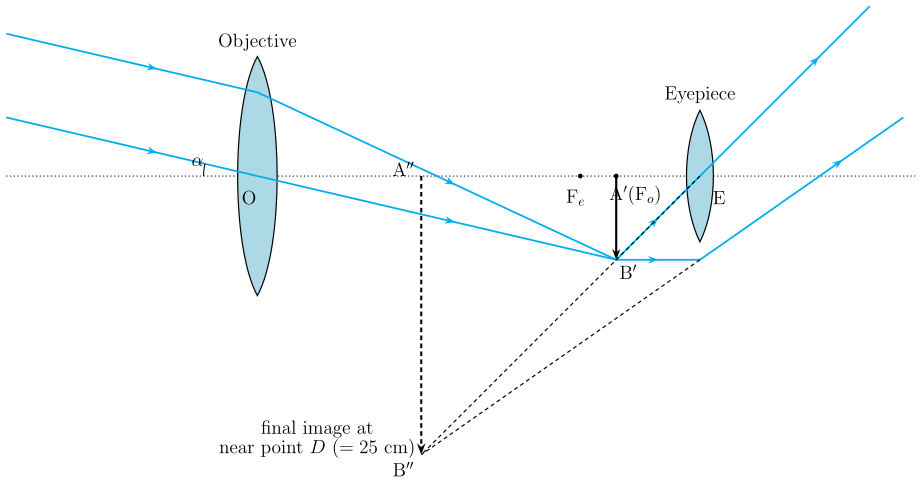
Objective makes a real image at its focus; eyepiece magnifies it to . .
Ray diagram (description). A refracting telescope has a large-aperture, long-focal-length objective and a short-focal-length eyepiece on a common axis.
- Parallel rays from a distant object enter the objective and converge to form a real, inverted image in its focal plane (at ).
- This image lies just inside the focal length of the eyepiece, so the eyepiece acts as a simple magnifier, forming a final magnified, virtual, inverted image at the least distance of distinct vision cm from the eye.
- (In a sketch: an axial ray and a chief ray from the object cross at on the axis-image; two rays from diverge through the eyepiece and, projected back, meet at the enlarged final image.)
Magnifying power (final image at ):
…
Unlock everything free for 14 days
- Full step-by-step solutions
- Concept-first explanations
- Methods, shortcuts & mistakes
- PYQ mapping + timed mock tests
Full access for 14 days. No credit card required.