Question of 73
Q.Draw a ray diagram of reflecting telescope. Explain its working.
Uttar Pradesh UpmspUP Board (UPMSP) Intermediate 2025Subjective· 3mImportance★★★★★
0% · 0/73 Questions
You're viewing a preview — the full solution, concept, methods & PYQ mapping are locked.
Start your 14-day free trial to unlock the full solution →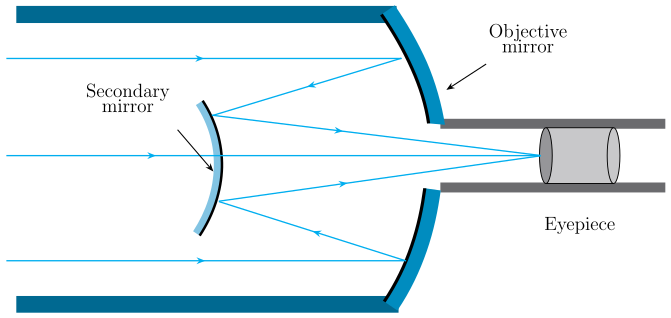
In a reflecting telescope a large concave mirror gathers light and focuses it (via a small secondary mirror) into an eyepiece; magnification . Mirrors avoid chromatic aberration and can be made very large.
Principle. A reflecting telescope uses a large concave parabolic mirror as its objective (instead of a lens) to collect light from a distant object and bring it to a focus. A lens near this focus (the eyepiece) magnifies the image.
Working (Cassegrain form).
- Parallel rays from a distant star fall on the large concave primary mirror and converge toward its focus.
- Before converging, they strike a small convex secondary mirror placed on the axis, which reflects them back through a hole at the centre of the primary.
- The eyepiece behind the hole forms a magnified virtual image for the observer.
Magnifying power.
where is the focal length of the objective mirror and that of the eyepiece.
…
Unlock everything free for 14 days
- Full step-by-step solutions
- Concept-first explanations
- Methods, shortcuts & mistakes
- PYQ mapping + timed mock tests
Full access for 14 days. No credit card required.