Economics · Ch 1 — Introduction
Consumption, Production and Distribution
Consumption, Production and Distribution
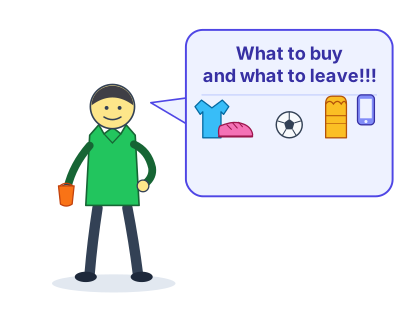
Drawn by us to help you understand the concept clearly, and verified to make sure it's accurate. For exams, practice from your textbook's own diagram.
Our own line-art recreation of the NCERT cartoon printed at the top of this section (p.3), where the boy's speech bubble reads “What to buy and what to leave!!!” over a T-shirt, a shoe, a football, a snack packet and a phone-like gadget. It illustrates the very point the adjoining prose makes about Consumption — a consumer, given a fixed income, a range of goods, and knowledge of their prices, must decide what to buy and what to leave. The scene and the objects shown are facts taken from …
Economics is the study of man engaged in economic activities of various kinds. To understand these activities, Economics is conventionally organised into three parts — consumption, production, and distribution.
- Consumption — the study of how a consumer, given a fixed income, a range of goods to choose from, and knowledge of their prices, decides what to buy.
- Production — the study of how a producer decides what to produce and how to produce it for the market.
- Distribution — the study of how the total income generated in the country — the Gross Domestic Product (GDP) — is shared out through wages (and salaries), profits, and interest. (Income arising from international trade and investment is set aside here.)
Beyond these three conventional divisions, modern economics also takes up some of the basic problems facing the country for special study. For example, one may wish to know why some households can earn far more than others; how many people are poor, how many are middle-class, and how many are relatively rich; how many are illiterate or unemployed; and how educational opportunity relates to the jobs people can get. In other words, we often want facts stated in terms of numbers that answer questions about poverty and inequality in society.
Economists also study the impact of events such as disasters — a tsunami, an earthquake, or an outbreak of bird flu — which affect people's ordinary business of life enormously. To analyse any of these problems, an economist must be able to collect the relevant facts and put them together systematically and correctly — which is exactly why the study of numbers, or Statistics, becomes part of modern economics. …