Chemistry · Ch 1 — Some Basic Concepts of Chemistry
Temperature
Temperature
Temperature
Temperature is a measure of how hot or cold an object is. It is a fundamental physical quantity, and in chemistry, controlling and measuring temperature is essential because reaction rates, equilibrium positions, and physical states all depend on it.
Three common scales are used to measure temperature: the Celsius scale (°C), the Fahrenheit scale (°F), and the Kelvin scale (K). The Kelvin scale is the SI unit of temperature.
The Celsius and Fahrenheit Scales
The Celsius scale is built around the freezing and boiling points of water at standard atmospheric pressure. On this scale, the freezing point of water is defined as 0 °C, and the boiling point is defined as 100 °C. The interval between these two points is divided into 100 equal parts, each representing one degree Celsius.
The Fahrenheit scale uses different reference points. The freezing point of water is 32 °F, and the boiling point is 212 °F. The interval between them is divided into 180 equal parts.
Because the two scales have different zero points and different-sized degrees, a simple linear relationship connects them. A change of 100 °C corresponds to a change of 180 °F, so one Celsius degree is times as large as one Fahrenheit degree. The relationship is:
This formula lets you convert any Celsius temperature to Fahrenheit. To go the other way, you can rearrange it:
A quick mental check: at , both scales read the same value. Plug into the formula: . This is the only temperature where the two scales coincide.
The Kelvin Scale and Absolute Zero
The Kelvin scale is an absolute temperature scale, meaning its zero point is the lowest possible temperature that can theoretically be reached. This point, called absolute zero, is the temperature at which all molecular motion ceases (in the classical sense). The Kelvin scale is related to the Celsius scale by a simple shift:
This means that 0 K (absolute zero) corresponds to °C. The size of one Kelvin is exactly the same as the size of one degree Celsius — a change of 1 K is identical to a change of 1 °C.
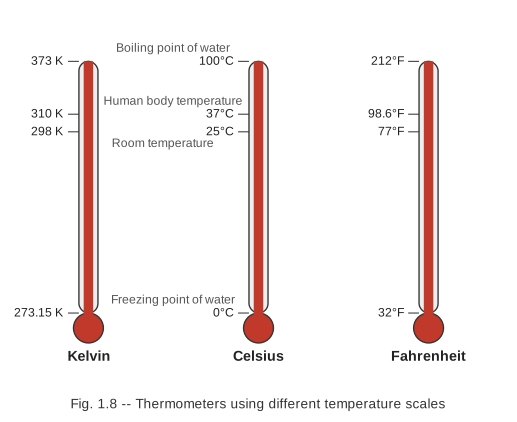
Drawn by us to help you understand the concept clearly, and verified to make sure it's accurate. For exams, practice from your textbook's own diagram.
Fig. 1.8 lines up all three temperature scales side by side against the same four reference points. The boiling point of water reads 373 K, 100 degC, and 212 degF. Human body temperature reads about 310 K, 37 degC, and 98.6 degF. Room temperature reads about 298 K, 25 degC, and 77 degF. The freezing point of water reads 273.15 K, 0 degC, and 32 degF. Lining the three columns up this way is …
A common mistake is to forget the 0.15. While many problems round 273.15 to 273, the exact value is 273.15. In precise calculations, especially those involving gas laws or thermodynamic data, using the exact value is critical.
Negative Temperatures: A Key Difference
A crucial distinction between the Celsius and Kelvin scales is that negative temperatures are possible on the Celsius scale but impossible on the Kelvin scale.
On the Celsius scale, temperatures below 0 °C are common — for example, a cold winter day might be °C. This is perfectly meaningful because the zero point is arbitrary (the freezing point of water). …