Chemistry · Ch 5 — Thermodynamics
Work
Work
The Meaning of Work in Thermodynamics
In thermodynamics, work is not just any kind of effort — it is a precisely defined mode of energy transfer between a system and its surroundings. The section focuses on one specific type: mechanical work, also called pressure-volume work (or -work). This is the work done when a system changes its volume against an external pressure.
Why only mechanical work? In chemistry, the most common way a system does work on its surroundings (or has work done on it) is through expansion or compression. A gas expanding in a cylinder pushes a piston; that is work. A gas being compressed by a piston has work done on it. All other forms of work (electrical, magnetic, etc.) are set aside for now.
Deriving the Expression for Pressure-Volume Work
Consider a cylinder fitted with a frictionless piston, containing one mole of an ideal gas. The gas has an initial volume and an internal pressure . The piston has a cross-sectional area . An external pressure acts on the piston from the outside.
If , the piston is pushed inward, compressing the gas. The piston moves a distance . The change in volume is:
The negative sign appears because compression reduces volume. The force exerted by the external pressure on the piston is:
Work done on the system (by the surroundings) is force times distance:
But (since is positive but is negative for compression). Therefore:
And since , we get the general formula for work done in a single-step process at constant external pressure:
Why the negative sign? It is a convention. In thermodynamics, work done on the system is taken as positive. For compression, , so is negative. The product then becomes positive — exactly what we want. For expansion (, positive), the same formula gives a negative value for , meaning work is done by the system (energy leaves it).
The sign convention is the most common source of confusion. Always check: is the volume decreasing (compression, ) or increasing (expansion, )? The formula handles both automatically.
Work When Pressure Changes in Finite Steps
If the external pressure is not constant but changes in a series of discrete steps, the total work is the sum of the work done in each step. For each small step where the external pressure is and the volume change is , the work is . Summing over all steps:
This is a finite sum. Graphically, on a - plot, each term corresponds to the area of a rectangle of height and width . The total work is the total shaded area under the stepwise curve.
Reversible Work: The Continuous Limit
Now consider a process where the external pressure is changed infinitely slowly, so that at every instant the external pressure is only infinitesimally different from the internal pressure of the gas. For compression, we have ; for expansion, . In either case, we can write .
Such a process is called a reversible process. A reversible process is one that can be reversed at any moment by an infinitesimal change in a variable. It proceeds through a continuous series of equilibrium states, with the system and surroundings always nearly in equilibrium.
Reversible processes are idealizations. No real process is perfectly reversible, but many can be approximated as such. The key point is that reversible work is the maximum work that can be obtained from a system during expansion, and the minimum work required to compress it.
For an infinitesimal volume change , the work done on the system is:
Substituting :
The term is the product of two infinitesimals and is negligible. Therefore, for a reversible process:
Since the system is always in equilibrium, is simply the pressure of the gas, which we denote as . The total reversible work for a finite change from to is obtained by integration:
This is the central result. The integral is the area under the - curve for the reversible path.
Reversible Isothermal Work for an Ideal Gas
For an ideal gas, the pressure and volume are related by the ideal gas law: . At constant temperature (isothermal process), . Substituting into the reversible work integral:
Since , , and are constants:
Using the conversion , we also write:
For expansion (), the logarithm is positive, so is negative — work is done by the system. For compression, the opposite holds.
The formula is one of the most frequently used equations in thermodynamics. Memorise it, but also understand where it comes from: the ideal gas law plus the definition of reversible work.
Free Expansion
Free expansion is expansion into a vacuum. The external pressure . From the general formula , we immediately get:
…
Drawn by us to help you understand the concept clearly, and verified to make sure it's accurate. For exams, practice from your textbook's own diagram.
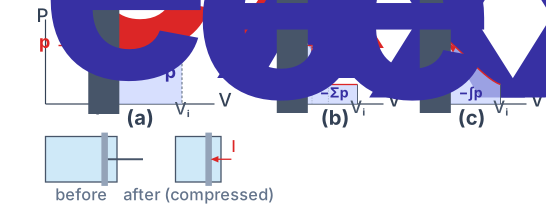
Fig. 5.5 is the conceptual bridge between the everyday idea of "pushing a piston" and the mathematical expression for pressure-volume work. The figure is split into three panels, each showing the same compression process but at different levels of realism.
Panel (a) — the simplest case — shows a P–V graph with volume on the horizontal axis and pressure on the vertical. A horizontal line runs at a constant pressure , the fixed external pressure applied to the piston. Two vertical lines mark the initial volume and the final volume , with to the left of because the gas is compressed. The rectangle bounded by these three lines and the volume axis is shaded. Its area is , which equals — the work done on the gas. Below the graph, a cylinder-and-piston sketch shows the piston moving inward a distance against the external pressure, making the physical meaning of the shaded area concrete.
Panel (b) shows a compression carried out in several finite steps. The P–V plot now has a staircase shape: the external pressure is raised in discrete jumps, and at each step the volume decreases by a finite amount . The total work is the sum of the rectangular areas under each step, written as . This is still an irreversible process because the gas is never in equilibrium with the surroundings during the jumps.
Panel (c) depicts the reversible limit. Here the external pressure is increased in infinitesimally small steps, so the P–V curve becomes a smooth, continuous line. The shaded area under this curve represents the work done on the gas, given by the integral . Under reversible conditions, differs from the gas pressure by only an infinitesimal , so we can replace with and write .
The central formula that emerges from this figure is the expression for reversible isothermal work on an ideal gas:
where is the number of moles, the gas constant, the absolute temperature, the initial volume, and the final volume. The negative sign ensures that work done on the system (compression, ) comes out positive.
The figure teaches a single, powerful idea: the work done on or by a gas is the area under the P–V curve, but the shape of that curve depends on how the process is carried out. A single-step compression gives a rectangle; a multi-step compression gives a staircase; a reversible compression gives a smooth curve whose area is smaller than the rectangle for the same volume change. This is why reversible work is the minimum work required to compress a gas — and the maximum work obtainable from an expansion. …