Mathematics · Ch 10 — Conic Sections
Latus Rectum
Latus Rectum
Latus Rectum of a Parabola
The latus rectum is a special line segment that helps us measure the "width" of a parabola at its focus. Think of it as the chord that passes through the focus and runs perpendicular to the axis of symmetry.
Definition: The latus rectum of a parabola is the line segment that:
- Passes through the focus
- Is perpendicular to the axis of the parabola
- Has its endpoints lying on the parabola
This segment is always vertical for parabolas that open left or right, and horizontal for parabolas that open up or down.
Length of the Latus Rectum for
Consider the standard parabola that opens to the right. Its focus is at and its axis is the x-axis. The latus rectum is the chord through the focus perpendicular to the x-axis — so it's a vertical line through .
To find its length, we need the y-coordinates of the points where this vertical line meets the parabola.
Substitute into :
So the endpoints of the latus rectum are and .
The distance between these two points is:
The textbook also gives a geometric proof using the definition of a parabola. Let's trace through it.
›Proof
Geometric derivation:
Let AB be the latus rectum of the parabola , with A and B as its endpoints on the parabola, and F as the focus at .
By the definition of a parabola, for any point on the parabola, the distance to the focus equals the distance to the directrix.
For point A: , where C is the foot of the perpendicular from A to the directrix.
The directrix of is . The distance from A to the directrix equals the horizontal distance from A to the line .
Since A lies on the vertical line through the focus, its x-coordinate is . So .
Therefore .
By symmetry of the parabola about the x-axis, .
Hence .
Properties of the Latus Rectum
The latus rectum has several useful properties that appear frequently in problems:
(I) For the parabola , the endpoints of the latus rectum are and .
(II) The length of the latus rectum is for any parabola of the form or . …
Definition. For a parabola, the latus rectum is the line segment that passes through the focus, is perpendicular to the axis of the parabola, and has its endpoints on the parabola.
Intuition. Think of the latus rectum as the "width" of the parabola measured right at the focus — it tells you how wide the curve opens at that single special point. The axis is the line of symmetry; the latus rectum cuts across it at a right angle, straddling the focus.
Length. For the standard parabola (opening to the right), the length of the latus rectum is . This comes from the definition: the distance from the focus to the parabola along the latus rectum is , and because the parabola is symmetric about the -axis, the full segment is twice that, giving . …
Definition. For a parabola, the latus rectum is the line segment that passes through the focus, is perpendicular to the axis of the parabola, and has its endpoints on the parabola.
Intuition. Think of the latus rectum as the "width" of the parabola measured right at the focus — it tells you how wide the curve opens at that single special point. The axis is the line of symmetry; the latus rectum cuts across it at a right angle, straddling the focus.
Length. For the standard parabola (opening to the right), the length of the latus rectum is . This comes from the definition: the distance from the focus to the parabola along the latus rectum is , and because the parabola is symmetric about the -axis, the full segment is twice that, giving . …
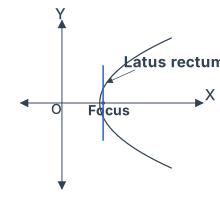
Drawn by us to help you understand the concept clearly, and verified to make sure it's accurate. For exams, practice from your textbook's own diagram.
The figure shows a standard right‑opening parabola drawn on an ordinary ‑plane. The vertex is at the origin , and the axis of the parabola is the positive ‑axis. The focus lies on this axis, inside the curve. A blue line segment is drawn through the focus, perpendicular to the axis — that is, vertical — with its two endpoints touching the parabola. This segment is labelled Latus rectum.
The physical idea is simple: the latus rectum is the chord of the parabola that passes through the focus and is perpendicular to the axis. It is the widest chord you can draw through the focus, and its length turns out to be a clean, fixed multiple of the focal distance . The figure makes this geometric definition concrete: you see the focus, the axis, and the perpendicular chord all in one picture.
From this diagram the textbook derives the length of the latus rectum for the standard parabola . Here is the reasoning step by step.
Let the endpoints of the latus rectum be and , with above the ‑axis and below. By definition of a parabola, every point on the curve is equidistant from the focus and the directrix. For point , this means , where is the foot of the perpendicular from to the directrix. But is exactly the horizontal distance from to the directrix, which equals the distance — the distance from the focus to the directrix. Since the focus is at and the directrix is , we have . Hence .
The parabola is symmetric about the ‑axis, so . Therefore the full length .
Do not confuse the latus rectum with the focal chord in general. Any chord through the focus is a focal chord; the latus rectum is the specific focal chord perpendicular to the axis. Its length is a constant for a given parabola, independent of which point on the parabola you pick. …
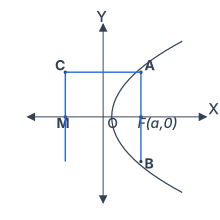
Drawn by us to help you understand the concept clearly, and verified to make sure it's accurate. For exams, practice from your textbook's own diagram.
Fig. 10.18 is a coordinate-plane diagram of the parabola (with ). The x-axis is horizontal, the y-axis vertical. The parabola opens to the right, with its vertex at the origin . The axis of the parabola is the x-axis itself.
The focus is labelled — a point on the x-axis inside the right-opening curve. The directrix is the vertical line , and the point where this line meets the x-axis is labelled . The latus rectum is drawn as a vertical blue line segment through , with endpoints on the parabola: above the x-axis and below it. So the latus rectum runs from straight down to , passing through at its midpoint.
The figure also shows a point — directly above at the same height as . The segments (horizontal from to ) and (vertical from down to ) are drawn, completing a rectangle . This rectangle is the key visual device: it shows that (by the definition of a parabola — every point on the parabola is equidistant from the focus and the directrix). Since is the horizontal distance from to , and lies on the directrix line , we have . Therefore . By symmetry across the x-axis, , so the full length of the latus rectum .
Here is the distance from the vertex to the focus (and also from the vertex to the directrix). For a parabola , the latus rectum is always — a fixed number that depends only on , not on which point on the parabola you pick. This result is used directly in problems: for example, in Example 5 of the textbook, gives , so the latus rectum length is . …
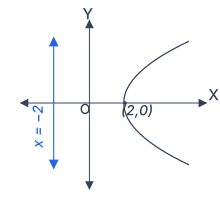
Drawn by us to help you understand the concept clearly, and verified to make sure it's accurate. For exams, practice from your textbook's own diagram.
Fig. 10.19 is a clean, standard plot of the parabola drawn on the usual – coordinate axes. The curve opens to the right, with its vertex at the origin . The -axis is the axis of symmetry of the parabola — the curve is symmetric about it. The focus is marked at , and the directrix is drawn as a vertical blue line at . The latus rectum is the chord through the focus perpendicular to the axis; its endpoints lie on the parabola, and its total length is units (from to at ).
The physical idea the figure teaches is the focus-directrix definition of a parabola: every point on the curve is equidistant from the focus and the directrix . For , the distance from any point on the parabola to the focus equals its perpendicular distance to the line . The vertex is the midpoint of the perpendicular from the focus to the directrix, so it lies exactly halfway between them — at .
The figure directly illustrates the standard form with . Here is the distance from the vertex to the focus, and also the distance from the vertex to the directrix (but on the opposite side). The latus rectum length is .
The key formula the textbook develops with this figure is the latus rectum length:
For , comparing with gives , so . The derivation in the text shows why: by the definition of the parabola, where is the vertex, the focus, and the foot of the perpendicular from to the directrix. Since (the distance from the focus to the directrix is ), we get . By symmetry, the full chord is twice that, hence . …