Mathematics · Ch 12 — Limits and Derivatives
Derivatives
Derivatives
The Meaning of a Derivative
The idea of a derivative grows directly out of a practical question: how fast is something changing? If you know where a car is at different times, you can work out its speed. If you know the depth of water in a reservoir at several moments, you can predict when it will overflow. Rocket scientists need the velocity of a satellite at the instant it leaves the rocket, knowing the rocket's height over time. In every case, we want to know how one quantity changes with respect to another.
The derivative of a function at a point is the precise mathematical tool that answers this. It measures the instantaneous rate of change of the function at that point.
Definition of the Derivative at a Point
Suppose is a real-valued function and is a point in its domain. The derivative of at is defined as
provided this limit exists. The notation is read as "f-prime of a". This limit quantifies exactly how is changing at the specific point .
The denominator is , not . A common mistake is to write or to forget that the numerator must be the change in the function value over an interval of length .
Geometric Interpretation
Let be a function. Take two points on its graph: and , where is a small non-zero number. Draw the chord . In triangle (where is the point directly below at the same height as ), the ratio
is exactly , which is the slope of the chord .
Now let approach . The point slides along the curve towards , and the chord rotates until it becomes the tangent line to the curve at . The limit of the slope of the chord is therefore the slope of the tangent. Hence
where is the angle the tangent line makes with the positive -axis. The derivative at a point is the slope of the tangent to the curve at that point.
This geometric view is why derivatives are so powerful: they connect algebra (the limit of a ratio) with geometry (the slope of a tangent).
The Derivative as a Function
If the derivative exists at every point in the domain of , then it defines a new function called the derivative of . This is the formal definition.
This definition is also called the first principle of derivatives. The domain of is the set of all for which this limit exists. …
The derivative of a real-valued function at a point in its domain is defined as:
provided this limit exists. The notation is read as "f-prime of a".
If the derivative exists at every point in the domain of , then it defines a new function, called the derivative of , given by:
wherever the limit exists. This is also called the first principle of derivative. The domain of is exactly the set of points where the above limit exists.
The derivative is also denoted by or, if , by . At a specific point , you may see or .
Intuition: The derivative measures the instantaneous rate of change of with respect to at a given point. Geometrically, is the slope of the tangent line to the curve at the point .
Concrete example: For , the derivative at is: …
The derivative of a real-valued function at a point in its domain is defined as:
provided this limit exists. The notation is read as "f-prime of a".
If the derivative exists at every point in the domain of , then it defines a new function, called the derivative of , given by:
wherever the limit exists. This is also called the first principle of derivative. The domain of is exactly the set of points where the above limit exists.
The derivative is also denoted by or, if , by . At a specific point , you may see or .
Intuition: The derivative measures the instantaneous rate of change of with respect to at a given point. Geometrically, is the slope of the tangent line to the curve at the point .
Concrete example: For , the derivative at is: …
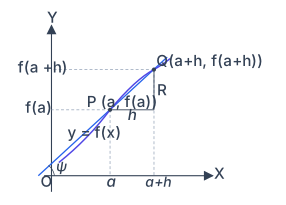
Drawn by us to help you understand the concept clearly, and verified to make sure it's accurate. For exams, practice from your textbook's own diagram.
What Fig. 12.11 Shows
The figure plots a smooth, increasing curve on standard - axes. Two specific points are marked on this curve: and , where is a small non-zero number. A dashed vertical guide drops from to the -axis at , and another from to . Similarly, dashed horizontal guides run from and to the -axis at and .
The secant line is drawn as a straight chord connecting the two points, and this line is extended until it meets the -axis. The angle that this extended secant makes with the positive -axis is labelled . A right triangle is constructed: and are the two points on the curve, and is the point directly below and horizontally aligned with . The horizontal leg has length (the change in ), and the vertical leg has length (the change in ).
The Physical Idea
The figure translates the abstract limit definition of a derivative into a concrete geometric picture. The ratio is exactly the slope of the secant line . In triangle , this ratio equals , which is the same as because is the angle the secant makes with the horizontal.
As shrinks toward zero, slides along the curve toward . The secant rotates and approaches a limiting line — the tangent to the curve at . The slope of this tangent is the limit of the secant slopes, which is precisely . The figure shows that this limiting slope equals , where is now the angle the tangent makes with the -axis.
The derivative is the slope of the tangent line to at . Geometrically, , where is the angle the tangent makes with the positive -axis.
The Key Formula
The textbook develops the definition of the derivative from this figure:
Each symbol means:
- — the derivative of at the point
- — a small increment in (the horizontal distance in the triangle)
- — the corresponding change in (the vertical leg )
- — the slope of the secant , equal to for the secant …