Mathematics · Ch 9 — Straight Lines
Horizontal and Vertical Lines
Horizontal and Vertical Lines
Horizontal and Vertical Lines
When a line is horizontal, every point on it has the same y-coordinate. If a horizontal line L is at a distance from the x-axis, then the y-coordinate of every point on L is either or . Which one it is depends on whether the line lies above the x-axis (positive distance) or below it (negative distance).
Similarly, a vertical line has the same x-coordinate for all its points. If a vertical line is at a distance from the y-axis, then the x-coordinate of every point on it is either or , depending on whether the line is to the right or left of the y-axis.
The distance is always taken as a positive number. The sign in the equation tells you which side of the axis the line lies on.
Equation of a Horizontal Line
Consider a horizontal line L at a distance from the x-axis. The ordinate (y-coordinate) of every point on L is constant. If the line is above the x-axis, the ordinate is ; if below, it is .
Therefore, the equation of the horizontal line is:
The sign is chosen based on the position of the line relative to the x-axis.
Equation of a Vertical Line
Now consider a vertical line at a distance from the y-axis. The abscissa (x-coordinate) of every point on this line is constant. If the line is to the right of the y-axis, the abscissa is ; if to the left, it is .
Therefore, the equation of the vertical line is:
The sign is chosen based on the position of the line relative to the y-axis.
Example: Lines Through a Given Point
Example 4: Find the equations of the lines parallel to the axes and passing through the point .
Solution:
We need two lines: one horizontal (parallel to the x-axis) and one vertical (parallel to the y-axis), both passing through .
Horizontal line through :
Every point on a horizontal line has the same y-coordinate. Since the line passes through , the y-coordinate of every point on it is . Therefore, the equation is:
…
Drawn by us to help you understand the concept clearly, and verified to make sure it's accurate. For exams, practice from your textbook's own diagram.
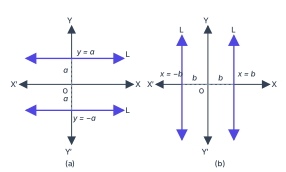
Fig 9.8 is a simple coordinate-plane sketch split into two side-by-side panels, (a) and (b). Its purpose is to show the geometric meaning of the equations of horizontal and vertical lines — the most basic lines after the axes themselves.
Panel (a) shows the -axis and -axis. Two horizontal lines are drawn: one above the -axis, labelled , and one below it, labelled . A dashed vertical segment runs from the origin straight up to the line , and another dashed segment runs straight down to . Each dashed segment is marked with the length . The idea is immediate: every point on the upper line has -coordinate ; every point on the lower line has -coordinate . The distance of each line from the -axis is exactly .
Panel (b) is the same idea rotated. Two vertical lines are drawn: one to the right of the -axis, labelled , and one to the left, labelled . Dashed horizontal segments from the origin go right to and left to , each marked with length . Every point on the right-hand line has -coordinate ; every point on the left-hand line has -coordinate . The distance of each line from the -axis is .
The physical idea is that a line parallel to an axis is completely described by a single coordinate — the constant value of the other coordinate. A horizontal line never changes its ; a vertical line never changes its . The sign of the constant tells you which side of the origin the line lies on.
…
Drawn by us to help you understand the concept clearly, and verified to make sure it's accurate. For exams, practice from your textbook's own diagram.
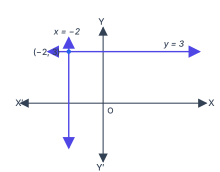
The figure shows a standard Cartesian plane with four quadrants. Two lines are drawn: a vertical line labelled and a horizontal line labelled . Both lines are shown as double-arrowed indigo lines, meaning they extend infinitely in both directions. The point where they cross is marked as .
The physical idea is straightforward. A horizontal line is defined by the fact that every point on it has the same -coordinate. A vertical line is defined by the fact that every point on it has the same -coordinate. The figure makes this concrete: the horizontal line through is the set of all points whose -coordinate is 3, regardless of . The vertical line through the same point is the set of all points whose -coordinate is , regardless of .
The textbook uses this figure to develop the equations of lines parallel to the axes. The key result is:
for a horizontal line at distance from the -axis, and
for a vertical line at distance from the -axis.
In the specific case of the point :
- The horizontal line through it is (since the point is above the -axis, the sign is positive).
- The vertical line through it is (since the point is to the left of the -axis, the sign is negative). …