Physics · Ch 4 — Laws of Motion
The Law of Inertia
The Law of Inertia
The Idea of Inertia
Before Newton, the prevailing view of motion — inherited from Aristotle — held that a force was needed to keep a body moving. A cart, for example, keeps rolling only as long as the horse pulls it; when the horse stops, the cart stops. This seems obvious from everyday experience. But Galileo, through a famous thought experiment, saw deeper.
Imagine a ball rolling down one incline and up another. The smoother the surfaces, the closer the ball gets to its original height on the second incline. Now make the second incline less and less steep. The ball travels farther and farther to reach that same height. In the limit — when the second incline is perfectly horizontal and the surfaces are perfectly smooth — the ball would never stop. It would keep moving forever at a constant speed, never slowing down.
Galileo concluded that a body in motion, left entirely to itself, will continue moving in a straight line at constant speed. The natural state of a body is not rest, but uniform motion. What we see in daily life — objects slowing down and stopping — is due to friction and other external influences, not to any inherent tendency of motion to die out. …
Drawn by us to help you understand the concept clearly, and verified to make sure it's accurate. For exams, practice from your textbook's own diagram.
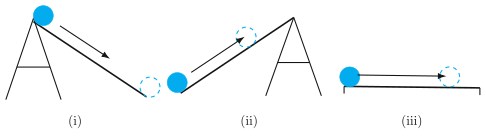
Galileo’s inclined-plane study is not a single experiment but a sequence of three thought experiments that strip away complications one by one. The figure shows three panels, each a side‑view sketch of a ball on a rigid surface.
Panel (i) — a single inclined plane. The ball is released from rest at the top and rolls down, gaining speed. The incline is the only cause of the motion; the steeper the slope, the faster the ball accelerates. This panel establishes that a net force (the component of gravity along the plane) produces acceleration.
Panel (ii) — a double incline shaped like a shallow valley. The ball is released from a height on the left slope, rolls down, crosses the bottom, and then rolls up the opposite slope. Galileo’s key observation: the ball rises to almost the same height from which it started, no matter how shallow the right slope is made. If friction is negligible, the ball reaches exactly the same height. This tells us that the ball’s motion uphill is a mirror of its motion downhill — the acceleration on the way up is opposite in direction but equal in magnitude to the acceleration on the way down.
Panel (iii) — a single horizontal plane. The ball is given a push and then rolls along a flat surface. With friction reduced as much as possible, the ball continues with constant velocity, neither speeding up nor slowing down. This is the crucial extrapolation: if the second incline in panel (ii) were made perfectly horizontal, the ball would never stop — it would keep moving forever at the same speed.
The physical idea is the law of inertia: a body continues in its state of rest or of uniform motion in a straight line unless compelled to change that state by an external force. The figure shows the logical path from “a force is needed to keep something moving” (the ancient view) to “no force is needed to keep something moving at constant velocity; a force is needed only to change the velocity.”
The figure directly motivates Newton’s first law. The horizontal plane in panel (iii) is the limiting case of the double incline in panel (ii) when the second slope is flattened to zero angle. In that limit, the ball never rises — it simply keeps going.
The textbook develops the quantitative relation for the acceleration of a body on a frictionless incline. For a plane inclined at an angle to the horizontal, the component of gravity along the plane is , where is the mass of the ball and is the acceleration due to gravity. Newton’s second law gives:
Here is the acceleration of the ball down the incline, , and is the angle of inclination. The mass cancels out — all objects slide down a given frictionless incline with the same acceleration, regardless of their mass. This is the quantitative result that Galileo’s inclined‑plane experiments (the real ones, with timing of rolling balls) were designed to verify. …
Drawn by us to help you understand the concept clearly, and verified to make sure it's accurate. For exams, practice from your textbook's own diagram.
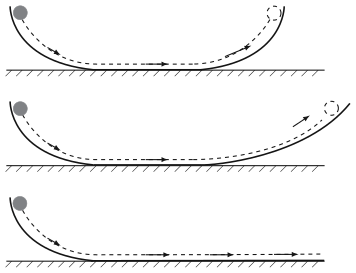
Galileo’s double inclined plane experiment is a thought experiment that leads directly to the law of inertia. The figure shows three panels stacked vertically, each with the same hatched ground and the same basic setup: a ramp on the left (the “release” plane) and a second ramp on the right (the “target” plane) whose slope changes from panel to panel.
In the top panel, both planes are steep and symmetric. A ball is released from rest at a certain height on the left ramp. Its path is shown as a dashed curve: it rolls down the left ramp, across the flat bottom (a short horizontal section), and then up the right ramp. The dashed curve reaches exactly the same height on the right ramp as the starting height on the left. This is the key observation — the ball returns to its original vertical height, no matter what.
In the middle panel, the right ramp is made less steep. The ball is released from the same height on the left. Again, the dashed path shows it rolling down, across the bottom, and up the gentler slope. This time it travels farther along the right ramp before stopping — but it still reaches the same vertical height as the starting point. The shallower the slope, the longer the horizontal distance covered.
In the bottom panel, the right ramp is horizontal — zero slope. The ball rolls down the left ramp, reaches the bottom, and then continues along the horizontal surface. The dashed path extends indefinitely to the right, with no upward turn. The ball never stops; it keeps moving at constant speed forever. The figure makes the logical conclusion visual: if the second plane is made less and less steep, the ball travels farther and farther to reach the same height. In the limiting case of a horizontal plane, the ball would never reach that height — it would go on forever.
The physical idea is profound. The ball’s motion is not “naturally” slowing down; it is being slowed by friction and air resistance. In the idealised case with no opposing forces, a moving object continues moving with the same speed in a straight line. This is the law of inertia: an object at rest stays at rest, and an object in motion stays in motion with constant velocity, unless acted upon by an external force.
The law of inertia is Newton’s first law of motion. It states that every object persists in its state of rest or uniform motion in a straight line unless compelled to change that state by forces impressed upon it.
The textbook develops this idea without a single formula in the figure itself — the figure is purely conceptual. However, the quantitative link comes from the work-energy principle. If we ignore friction, the gravitational potential energy at the start is completely converted to kinetic energy at the bottom, and then back to potential energy on the second ramp. For a ball of mass released from height :
where is the speed at the bottom. On the second ramp, the ball rises until its kinetic energy is again zero, so it reaches height again. The horizontal distance travelled on the second ramp depends on its slope : if the ramp makes angle with the horizontal, the distance along the ramp is
As , , so . This is the mathematical expression of the figure’s message: the gentler the slope, the farther the ball travels; for a horizontal plane (), the distance becomes infinite — the ball never stops. …