Business Studies · Ch 9 — Financial Management
Investment Decision
Investment Decision
Investment Decision
A firm has limited resources but many possible uses for them. The investment decision is about choosing where to put those resources so that investors earn the highest possible return. In simple terms, it answers the question: Which assets should the firm invest in?
Investment decisions are of two types: long-term and short-term.
Long-Term Investment Decision (Capital Budgeting)
A long-term investment decision is called a Capital Budgeting decision. It involves committing funds on a long-term basis — for years, often decades. Examples include buying a new machine to replace an old one, acquiring a new fixed asset like a factory or land, or opening a new branch.
These decisions are crucial because they affect the firm's earning capacity in the long run. The size of the firm's assets, its profitability, and its competitiveness all depend on capital budgeting decisions. Moreover, such decisions usually involve huge amounts of money and are irreversible except at a huge cost. Once made, it is almost impossible for a business to back out. Therefore, they must be taken with utmost care.
Short-Term Investment Decision (Working Capital Decision)
Short-term investment decisions are also called working capital decisions. They are concerned with the levels of cash, inventory (stock of goods), and receivables (money owed by customers). These decisions affect the day-to-day working of a business. They influence both the liquidity (ability to pay short-term obligations) and profitability of the firm. Efficient management of cash, inventory, and receivables is essential for sound working capital management.
Factors Affecting Capital Budgeting Decisions
A business usually has several projects to choose from. Each project must be carefully evaluated. Based on the returns, a project is either selected or rejected. If only one project is available, its viability is checked by comparing its rate of return with the industry average.
The following factors affect capital budgeting decisions:
- Cash flows of the project When a firm invests a large amount, it expects to generate a series of cash receipts and payments over the life of the investment. These cash flows must be carefully analysed before making a decision.
- The rate of return This is the most important criterion. The decision is based on the Wealth Maximisation Concept — the goal is to maximise the wealth of shareholders. Calculations involve the expected returns from each proposal and the assessment of the risk involved. …
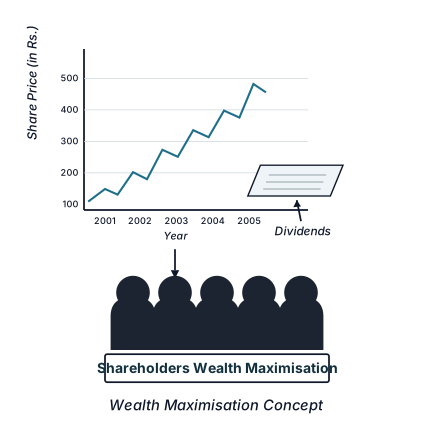
Drawn by us to help you understand the concept clearly, and verified to make sure it's accurate. For exams, practice from your textbook's own diagram.
Our own simplified rendering of the real page's illustration: a line graph plots the company's share price climbing year over year (2001 to 2005), alongside a stack of paper labelled "Dividends". Both point down to a row of shareholders, standing above a banner reading "Shareholders Wealth Maximisation". …