Q.Define an indifference map. Explain the conditions of consumer's equilibrium with the help of the indifference curve analysis.
You're viewing a preview — the full solution, concept, methods & PYQ mapping are locked.
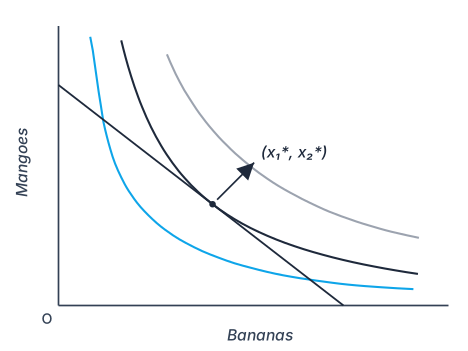
Start your 14-day free trial to unlock the full solution →Consumer's equilibrium is the point of tangency between the budget line and the highest attainable indifference curve, where MRS = Px/Py.
An indifference map is a set of several indifference curves for the same consumer, each representing a different (higher or lower) level of satisfaction — curves farther from the origin show higher satisfaction, and no two curves in the map ever intersect.
The consumer's budget line shows all combinations of the two goods purchasable by spending the entire given income at given prices. The consumer wants to reach the highest possible indifference curve, but is constrained to remain on or within the budget line. Graphically: draw the budget line AB (with Good X on the horizontal axis, Good Y on the vertical axis) and several indifference curves IC1, IC2, IC3 (IC3 farthest from origin, hence highest). The highest curve the consumer can actually reach while staying within the budget is the one just touching (tangent to) the budget line — say IC2 at point E. Any curve farther out (IC3) is unattainable (lies entirely outside the budget line), and any point on a lower curve (IC1) gives up satisfaction unnecessarily.
…
Unlock everything free for 14 days
- Full step-by-step solutions
- Concept-first explanations
- Methods, shortcuts & mistakes
- PYQ mapping + timed mock tests
Full access for 14 days. No credit card required.