Physical Education · Ch 3 — Yoga as Preventive Measure for Lifestyle Disease
Kapalabhati
Kapalabhati
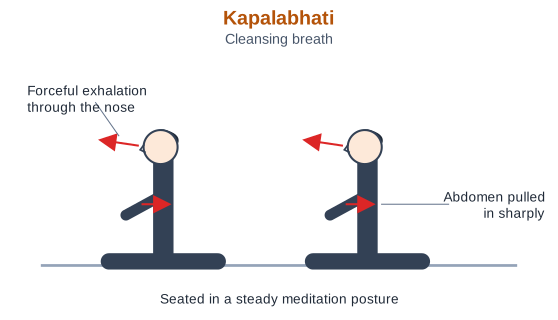
Kapalabhati is a cleansing breathing practice (a shatkarma / pranayama) that involves forceful and fast diaphragmatic breathing. Sitting in a comfortable position, one exhales forcefully by contracting the abdomen, and the inhalation that follows is passive. The forceful exhalations and passive inhalations are accompanied by abdominal movements and are done in quick succession, a number of times according to one's capacity.
Drawn by us to help you understand the concept clearly, and verified to make sure it's accurate. For exams, practice from your textbook's own diagram.
Two side-profile drawings of a person seated cross-legged in a meditation posture, placed side by side to show the breathing action. Small directional arrows at the nose and the abdomen mark the forceful exhalation with abdomi …
Benefits
- Is a great cleanser for the respiratory passages, including the sinuses.
- Improves respiratory function and promotes circulation.
- Improves balance.
- Removes acidity and gas-related problems.
- Helps relieve sinusitis, asthma and hair loss.
Precautions
- Pregnant women, slipped-disc patients and asthma patients should avoid it.
- It should not be performed during menstruation.
Although Kapalabhati is listed among the practices that help respiratory conditions, the textbook also lists asthma patients among those who should avoid the forceful form - so a student answering a CBSE 12 question should state both the benefit and this precaution honestly, exactly as the NCERT/CBSE syllabus does.
Step-by-step technique
- Sit in a comfortable meditation posture such as Padmasana, Sukhasana or Vajrasana, with the spine erect and the eyes closed.
- Rest the hands on the knees, and relax the shoulders and face.
- Take a few normal breaths to settle, then begin a sharp, forceful exhalation by pulling the abdominal (navel) muscles in quickly towards the spine.
- Let the inhalation that follows happen on its own, passively, as the abdomen relaxes outward; do not actively force the inhale.
- Continue this cycle of forceful exhalation and passive inhalation at a steady rhythm, starting slowly (around one round per second) and increasing pace only as capacity allows, for one round of about 20-30 strokes.
- Rest with normal breathing after each round, and repeat for 2-3 rounds depending on comfort and practice level.
Why Kapalabhati is prescribed for diabetes
The sharp, repeated contraction of the abdominal muscles acts almost like an internal massage on the pancreas, liver and intestines, driving blood through these organs with every forceful stroke. This repeated mechanical stimulation is believed to support pancreatic function and improve digestive efficiency, both directly relevant to blood-sugar regulation, which is why Kapalabhati appears in the diabetes list (section 3.2) even though, as the precautions above make clear, it must be avoided by asthma patients and during pregnancy or menstruation.
Common mistakes
- Forcing both the inhalation and the exhalation actively defeats the technique entirely; only the exhalation should be forceful, and the inhalation must stay completely passive and automatic. …