Q.Draw only diagrammatic representation of Miller's experiment.
🔒You're viewing a preview — the full solution, concept, methods & PYQ mapping are locked.
🔒 Start your 14-day free trial to unlock the full solution →Concept understanding — Darwinian Natural Selection
Imagine you walk into a crowded room. Some people are naturally louder, some are quieter. Some are taller, some shorter. Now imagine that, for some reason, the room is suddenly plunged into darkness, and everyone has to find the exit by touch alone. Who do you think will get out first? Probably not the loudest talker, but the person who happens to have the most sensitive fingertips or the best memory of where the door was.
That simple scenario captures the core of Darwinian natural selection. It is not about being "better" in some moral or absolute sense. It is about being a better fit for the specific situation you are in.
The Everyday Intuition: "Survival of the Fittest" — But What Does "Fittest" Mean?
The phrase "survival of the fittest" is often misunderstood. It does not mean the strongest, fastest, or most aggressive individual wins. In biology, "fitness" has a very specific meaning: the ability to survive long enough to reproduce and leave offspring.
Think of it this way: in a game of musical chairs, the "fittest" player isn't the one who dances the best. It's the one who, when the music stops, is standing on a chair. The chair is the environment. The player's ability to grab that chair is their fitness.
Darwin never used the phrase "survival of the fittest" in his first edition of On the Origin of Species. It was coined by Herbert Spencer, a philosopher, and Darwin adopted it in later editions. Darwin's own term was "natural selection," which is a more accurate description of the process.
The Precise Meaning: How Natural Selection Works
Natural selection is not a conscious force. It is a blind, automatic process that follows from three simple facts that are always true in any population of living things:
-
Variation: Individuals in a population are not identical. Even within a species, there is a range of traits — different beak sizes in birds, different fur colours in rabbits, different heights in humans. This variation is the raw material.
-
Inheritance: Many of these variations are passed from parents to offspring. A tall parent is more likely to have tall children. A fast-running cheetah is more likely to have fast-running cubs.
-
Differential Survival and Reproduction: More individuals are born than can possibly survive. Resources (food, water, shelter, mates) are limited. This creates a "struggle for existence." Individuals with traits that give them even a slight advantage in this struggle are more likely to survive and, crucially, to reproduce.
The result: Over many generations, the traits that helped those individuals survive and reproduce become more common in the population. The traits that were less helpful become rarer. The population gradually changes to become better suited to its environment.
Natural selection does not create new traits. It only acts on the variation that already exists. It is like a sieve, not a sculptor. The sieve lets through the grains of sand that are the right size for the hole, and holds back the rest. The environment is the sieve.
Why It Matters: The Engine of Adaptation
Natural selection is the mechanism that explains how life becomes adapted to its surroundings. It is why:
- A cactus has spines instead of leaves (to reduce water loss in a desert).
- A polar bear has white fur (to blend in with snow and ice).
- A human has an opposable thumb (to grip tools).
It is not a plan or a goal. It is a consequence of simple, observable facts playing out over vast stretches of time. The NCERT textbook for Class 12 Biology (Chapter 6, "Evolution") states this clearly: "Natural selection is a process in which heritable variations enabling better survival are enabled to reproduce and leave greater number of progeny."
A Few Key Points to Remember
- It acts on individuals, but it changes populations. An individual does not evolve. The population as a whole changes over generations. …
Miller and Urey's 1953 experiment recreated the conditions of the primitive Earth in the laboratory to test whether life's building blocks could form from simple gases — the diagram shows their apparatus. …
Draw Miller's sealed apparatus: a flask of CH4+NH3+H2+ water vapour with spark electrodes (~800 °C) (simulating lightning), a boiling water flask (the ocean), a condenser, and a U-trap that collected the newly-formed amino acids — proving abiotic (chemical) origin of life's building blocks.
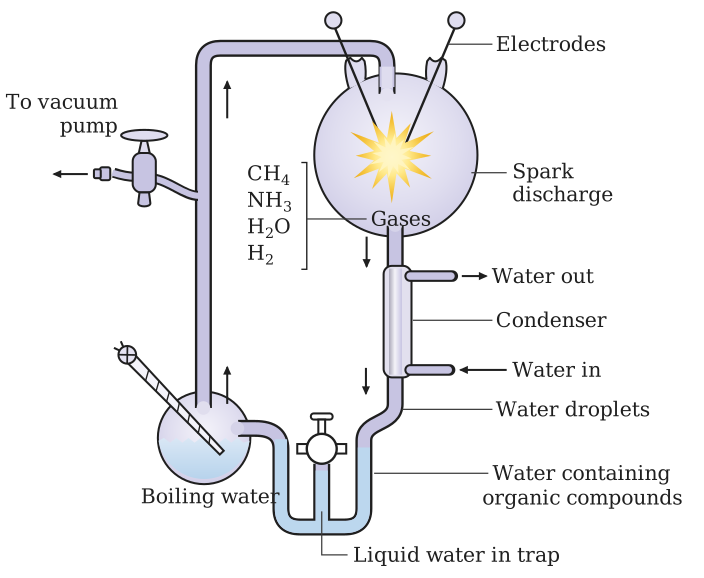
Concept
The Oparin–Haldane hypothesis proposed that life's first organic molecules formed chemically from simple inorganic gases in the conditions of the early Earth. Stanley Miller (1953) built an apparatus to test this.
The apparatus — parts to draw and label
Draw a closed, connected glass system and label:
- Reaction flask (upper, larger flask) — filled with the assumed primitive atmosphere gases: methane (CH4), ammonia (NH3), hydrogen (H2) and water vapour.
- Electrodes (spark discharge) — a pair of tungsten electrodes inside the flask that create a continuous electric spark/discharge at about 800 °C, simulating lightning in the primitive atmosphere.
- Water flask (lower, smaller flask) — containing water kept boiling to supply water vapour (representing the primitive ocean/sea).
- Condenser — a cooling tube that condenses the gaseous mixture after the spark, turning it back into liquid. …
Showing the 12 most recent of 30 on this concept.
- CBSE 2026Set 57/1/11 markMCQQ.Assertion (A) : The population of melanized moths increased in industrial areas after Industrial Revolution. Reason (R) : In Industrial environment lichen covered trees were replaced by soot-covered trees offering better camouflage to dark coloured moths. (A) Both Assertion (A) and Reason (R) are true and Reason (R) is the correct explanation for Assertion (A). (B) Both Assertion (A) and Reason (R) are true, but Reason (R) is not the correct explanation for Assertion (A). (C) Assertion (A) is true, but Reason (R) is false. (D) Assertion (A) is false, but Reason (R) is true.
›Reveal solutionSolution
The assertion and reason are both true, and the reason correctly explains why melanized moths became more common in industrial areas after the Industrial Revolution.
This question draws on one of the most famous and well-documented examples of natural selection in action — the peppered moth (Biston betularia) in England. The story is a classic illustration of how environmental change can drive evolutionary change, and it is directly covered in the NCERT Class 12 Biology textbook under the chapter on Evolution.
Before the Industrial Revolution, the typical peppered moth had a light, speckled appearance that blended beautifully with the lichen-covered bark of trees. This camouflage protected them from predatory birds. A dark, melanic form of the same species existed but was very rare, because it stood out starkly against the pale lichen and was easily spotted and eaten.
The Industrial Revolution changed the landscape dramatically. Soot and smoke from coal-burning factories coated trees and killed the lichen, turning the bark dark. Now the situation reversed: the light-coloured moths became highly visible against the soot-blackened trees, while the dark (melanized) moths were well-camouflaged. Birds now ate more of the light moths, and the dark moths survived and reproduced in greater numbers. Over several decades, the population shifted from mostly light to mostly dark in industrial areas.
NoteThis phenomenon is called industrial melanism. It is a textbook case of natural selection acting on a heritable trait, not a change acquired during the moth's lifetime.
Now look at the Assertion (A): "The population of melanized moths increased in industrial areas after Industrial Revolution." This is exactly what happened — the dark form became dominant in polluted regions. …
- CBSE 2026Set 57/3/11 markMCQQ.Appearance of antibiotic-resistant bacteria is an example of evolution due to : (A) Adaptive radiation (B) Divergent evolution (C) Artificial selection (D) Anthropogenic action
›Reveal solutionSolution
Antibiotic-resistant bacteria evolve through anthropogenic action — human use of antibiotics creates the selective pressure that favours resistant strains, a direct example of evolution driven by human activity.
Darwin's theory of natural selection rests on a simple but powerful idea: organisms with traits better suited to their environment survive and reproduce more successfully, passing those advantageous traits to the next generation. Over time, populations change. The environment acts as the selective agent, and the result is evolution.
Now consider what happens when we introduce antibiotics into bacterial populations. Before antibiotics, a bacterial colony contains natural genetic variation — most individuals are susceptible to the drug, but a tiny fraction carry random mutations that confer resistance. These resistant bacteria have no particular advantage in the absence of antibiotics; they're just different.
The moment we administer an antibiotic, the landscape shifts entirely. The drug kills or inhibits the susceptible bacteria, but the resistant ones survive. Suddenly, resistance is no longer a neutral quirk — it's a life-or-death advantage. The resistant bacteria reproduce freely in the now-emptied niche, and within generations the population is dominated by resistant strains. The antibiotic didn't create the resistance; it simply selected for bacteria that already possessed it.
This is evolution in fast-forward, and the selective pressure is unmistakably human in origin. We manufacture the antibiotics, we prescribe them, we use them in agriculture, and we often misuse them by stopping treatment early or deploying them unnecessarily. Each use is an evolutionary experiment, and bacteria — with their rapid generation times — respond with breathtaking speed.
Let's see why the other options don't fit:
-
Adaptive radiation describes the rapid diversification of a single ancestral species into multiple forms, each adapted to different ecological niches — think Darwin's finches spreading across the Galápagos. Antibiotic resistance doesn't involve branching into diverse new species; it's a single trait spreading through existing populations.
-
Divergent evolution occurs when related species accumulate differences over time as they adapt to different environments, eventually becoming distinct. Again, we're not watching bacterial species diverge into separate lineages here; we're watching one trait sweep through a population. …
-
- CBSE 2026Set 57/3/11 markMCQQ.Identify the statements that correctly describe Darwin's Theory of Evolution.(i) Overproduction of organisms leads to competition.(ii) Variation is inherited and causes evolution.(iii) Acquired characters are inherited.(iv) Survival depends on favourable traits.(v) New species arise due to accumulation of favourable variations. Choose the correct option. (A) (i), (ii),(iv) and(v) are correct (B) (ii),(iii) and(iv) are correct (C) All are correct (D) Only(i) and(iv) are correct
›Reveal solutionSolution
Darwin’s theory rests on overproduction, inherited variation, survival of the fittest, and the gradual accumulation of favourable variations — but it explicitly rejects the inheritance of acquired characters.
Darwin’s theory of evolution by natural selection is one of the most elegant and powerful ideas in biology. It explains how life changes over time without needing any guiding hand or purpose. The core logic is simple: organisms produce more offspring than can possibly survive, those offspring vary in their traits, and the environment “selects” the variants best suited to it. Over many generations, this process can give rise to entirely new species.
Let’s examine each statement in the question against what Darwin actually proposed.
Statement (i): Overproduction of organisms leads to competition.
This is absolutely correct. Darwin observed that every species has the potential to produce far more young than the environment can support. A single pair of elephants, for example, could in theory produce millions of descendants in a few centuries — yet elephant numbers remain roughly stable. The inevitable result is a struggle for existence: competition for food, shelter, mates, and safety. Overproduction sets the stage for natural selection.
Statement (ii): Variation is inherited and causes evolution.
Also correct. Darwin knew that individuals within a species differ from one another, and that many of these differences are passed from parents to offspring. He called this “inherited variation.” Without heritable variation, natural selection would have nothing to act upon — all individuals would be identical, and no change could occur. Evolution happens precisely because favourable variations are inherited and spread through a population.
Statement (iii): Acquired characters are inherited.
This is the one statement that does not belong to Darwin’s theory. The idea that traits acquired during an organism’s lifetime (like a blacksmith’s strong arm or a giraffe’s stretched neck) can be passed to offspring was proposed by Jean-Baptiste Lamarck, not Darwin. Darwin himself was unsure about the mechanism of inheritance, but he never made the inheritance of acquired characters a pillar of his theory. Modern genetics has shown that such acquired traits are not inherited — changes in body cells do not affect the DNA in eggs or sperm.
Watch outA common exam mistake is to confuse Lamarck’s idea with Darwin’s. Remember: Darwin said variation arises by chance and is then selected; Lamarck said organisms change in response to need and pass those changes on. They are fundamentally different.
Statement (iv): Survival depends on favourable traits. …
- CBSE 2026Set ANNUAL1 markQ.Which theory was given by Charles Darwin?
›Reveal solutionSolution
Darwin's theory of natural selection explains that organisms with heritable traits better suited to their environment survive and reproduce more successfully, gradually driving evolutionary change.
Charles Darwin, along with Alfred Russel Wallace, proposed the theory of Natural Selection, formally published by Darwin in 1859 in his book On the Origin of Species.
The key ideas of this theory are:
- Individuals within a population show heritable variations.
- Populations tend to produce more offspring than the environment can support, leading to a struggle for existence.
- Individuals with variations better suited ('fitter') to their environment are more likely to survive and reproduce — 'survival of the fittest'. …
- CBSE 2026Set ANNUAL1 markMCQQ.For a long time, it was believed that the organisms were fixed and unchanging. Which theory was proposed by Charles Darwin to challenge this belief?(a) Theory of Pangenesis(b) Theory of Use and Disuse(c) Theory of Natural Selection(d) Theory of Inheritance of Acquired Characters
›Reveal solutionSolution
Darwin's Theory of Natural Selection (published in 'On the Origin of Species', 1859) proposed that organisms change over generations through differential survival and reproduction of the fittest variants.
Darwin observed that organisms produce more offspring than the environment can support, that individuals show heritable variations, and that individuals better suited to the environment survive and reproduce more successfully ('survival of the fittest'). Over generations, favourable variations accumulate, driving evolutionary change. This directly challenged the older belief that species were fixed and unchanging.
…
- CBSE 2026Set ANNUAL1 markMCQQ.Identify the effect brought about by single step large mutation in evolution from the options given below :(a) Saltational speciation(b) Founder effect(c) Gene migration(d) Evolution by special creation
›Reveal solutionSolution
Speciation brought about by a single-step large mutation is called saltation (saltational speciation).
While Darwinian evolution emphasises gradual accumulation of small heritable variations, Hugo de Vries (working on Oenothera, the evening primrose) argued that mutation caused evolution and that large, sudden, single-step mutations — which he called saltation — could produce a new species in one step, rather than by slow, minor variations. Thus the effect of a single-step large mutation is saltational speciation.
…
- CBSE 2025Set A1 markQ.Match the correct pair and write the match for 'Darwin'. Column I:(i) Apomixis(ii) Darwin(iii) Toddy(iv) Agarose(v) Detritivorous. Column II:(a) Galapagos Islands(b) Southern India(c) Sea weeds(d) Earthworm(e) Grass family.
›Reveal solutionSolution
Darwin matches with (a) Galapagos Islands, the site of his famous finch observations during the voyage of the Beagle.
Charles Darwin, during his voyage aboard HMS Beagle, observed several closely related but distinct species of finches on the different islands of the Galapagos archipelago, each with beak shapes adapted to the specific food sources available on its island. These observations of adaptive radiation from a common anc …
- CBSE 2025Set ANNUAL1 markMCQQ.The essence of Darwinian theory about evolution is -(a) Mutation(b) Spontaneous generation(c) Natural selection(d) Chemical change
›Reveal solutionSolution
Darwin proposed that heritable variations giving a survival/reproductive advantage are naturally selected and become more common over generations.
Darwin's theory rests on the observations that populations show heritable variation, more offspring are produced than can survive, and individuals best suited to the environment survive and reproduce more successfully ('survival of the fittest'). This differential, non-random survival and reproduction of variants — natural selection — is the essence of Darwinism, driving gradual evolutionary change. Mutation is a source of variation (emphasised later by neo- …
- CBSE 2025Set ANNUAL1 markMCQQ.Assertion (A): Evolution is not occurring at present. Reason (R): Evolution takes a very long time to occur.(a) Both Assertion (A) and Reason (R) are true and Reason (R) is the correct explanation of Assertion (A).(b) Both Assertion (A) and Reason (R) are true, but Reason (R) is not the correct explanation of Assertion (A).(c) Assertion (A) is true but Reason (R) is false.(d) Both Assertion (A) and Reason (R) are false.
›Reveal solutionSolution
Evolution is a continuous, ongoing process happening in populations right now, so the Assertion is false; and while large-scale (macro)evolutionary change is typically slow, evolutionary/genetic change at the population level (microevolution) can be observed within a few generations, so the blanket Reason is also not correct.
The Assertion claims evolution is not occurring at present — this is factually false. Evolution is a continuous process driven by ongoing mutation, genetic recombination, gene flow, genetic drift, and natural selection acting on populations every generation. Directly observable modern examples include the rapid rise of antibiotic-resistant bacteria, pesticide-resistant insects, and the classic industrial melanism seen in the peppered moth (Biston betularia) population within a human lifetime — all clear evidence that evolutionary change is happening today, not just in the deep geological past.
…
- CBSE 2025Set ZOOLOGY1 markMCQQ.Which of the following is the modern concept of origin of life?(i) Special creation(ii) Spontaneous generation(iii) Biogenesis(iv) Chemical evolution
›Reveal solutionSolution
The modern concept of the origin of life is chemical evolution — life arose abiotically from simple molecules under early-Earth conditions.
The modern concept, the theory of chemical evolution proposed by Oparin and Haldane, holds that the first forms of life arose from non-living inorganic and organic molecules (chemogeny). Under the conditions of the primitive Earth — reducing atmosphere, energy from UV rays, lightning and heat — simple molecules combined to form complex organic molecules, then aggregates (coacervates/protobionts), and finally the first cells. The Miller–Urey experiment provided experimental support …
- CBSE 2024Set 57/3/11 markMCQQ.During the 1850s in the pre-industrialisation era in England, the expected effect of natural selection on the number of dark-winged moths as compared to white-winged moths was : (A) more in number (B) less in number (C) both were equal in number (D) both were less in number
›Reveal solutionSolution
Before industrialisation, tree bark was light-coloured and lichen-covered, making dark-winged moths conspicuous to predators while white-winged moths were camouflaged. Natural selection favoured the white form, so dark-winged moths were less in number.
This question tests your understanding of industrial melanism in Biston betularia (the peppered moth), one of the most elegant real-world demonstrations of natural selection in action. The key is to think about the environment before the soot and pollution arrived.
Natural selection operates through differential survival: individuals whose traits make them better camouflaged against predators leave more offspring. The trait frequencies in a population shift toward whatever the environment favours at that moment.
In pre-industrial England during the 1850s, the countryside was unpolluted. Tree trunks and branches were covered with light-coloured lichens, creating a pale, mottled background. Now picture two moths resting on such a tree:
-
The white-winged (light) moth blends beautifully into the lichen-covered bark. Birds hunting by sight struggle to spot it.
-
The dark-winged (melanic) moth stands out starkly against the pale background—a conspicuous target for any insectivorous bird.
Predation pressure acts as the selective force. Birds preferentially eat the moths they can see most easily. The dark moths suffer higher predation rates, so fewer survive to reproduce. Over generations, the dark allele remains rare in the population because its carriers are removed before they can pass it on.
TipRemember the rule: camouflage = survival. Whichever morph matches the background at the time will be favoured by selection. …
-
- CBSE 2024Set E1 markMCQQ.At which level is natural selection operated to evolve the desired traits?(a) Individual level(b) Population level(c) Community level(d) Ecosystem level
›Reveal solutionSolution
Natural selection operates at the POPULATION level, shifting the frequency of favourable traits over generations.
An individual organism cannot evolve within its own lifetime; it simply lives or dies, reproduces or does not. What changes over time is the genetic make-up of the whole POPULATION:
- Individuals carrying advantageous heritable variations survive and reproduce more successfully (differential reproduction). …
🎓Unlock everything free for 14 days
- ✓Full step-by-step solutions
- ✓Concept-first explanations
- ✓Methods, shortcuts & mistakes
- ✓PYQ mapping + timed mock tests
Full access for 14 days. No credit card required.