NCERT Exemplar · Q83
Q.Match each bromoalkene structure in Column I with its IUPAC name in Column II.
Column I (the four structures exactly as the Exemplar prints them):
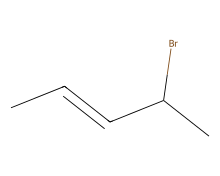
(i)
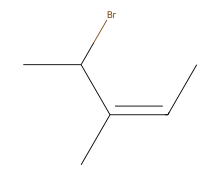
(ii)
(iii)
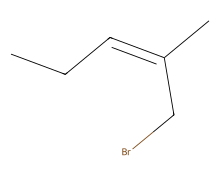
(iv)
Column II (names):
(a) 4-Bromopent-2-ene
(b) 4-Bromo-3-methylpent-2-ene
(c) 1-Bromo-2-methylbut-2-ene
(d) 1-Bromo-2-methylpent-2-ene
[!NOTE]
This question carries a printing error in the NCERT Exemplar itself: the book's
printed structure
(iii) is an exact duplicate of structure (i), and no printed
structure corresponds to name
(c) at all — yet the book's own answer key reads
(i)→(a), (ii)→(c), (iii)→(b), (iv)→(d), which does not match its own drawings.
We show the page exactly as printed and match what is actually drawn.
Uttarakhand UbseShort· 2mImportance★★★★★
84% · 123/147 Questions
You're viewing a preview — the full solution, concept, methods & PYQ mapping are locked.
Start your 14-day free trial to unlock the full solution →Naming each printed structure honestly gives (i) → (a), (ii) → (b), (iii) → (a) again (the book prints (iii) identical to (i)), and (iv) → (d). Name (c) matches nothing that is printed — the Exemplar's own key for this question contradicts its own drawings, a known printing error.
How each printed structure is named:
- Structure (i): . Five carbons, double bond between C2 and C3 (numbering from the end that gives the alkene the lower locant), Br on C4 → 4-bromopent-2-ene = (a).
- Structure (ii): . The same pent-2-ene skeleton with a methyl branch on C3 and Br on C4 → 4-bromo-3-methylpent-2-ene = (b).
- Structure (iii): . The book prints this identical to structure (i) — so as drawn it is again 4-bromopent-2-ene = (a). (The key's claim that (iii) → (b) would require a 3-methyl branch the printed drawing simply does not have.)
- Structure (iv): . Number from the Br end: Br on C1, methyl on C2, double bond C2=C3, five-carbon chain → 1-bromo-2-methylpent-2-ene = (d). …
Unlock everything free for 14 days
- Full step-by-step solutions
- Concept-first explanations
- Methods, shortcuts & mistakes
- PYQ mapping + timed mock tests
Full access for 14 days. No credit card required.