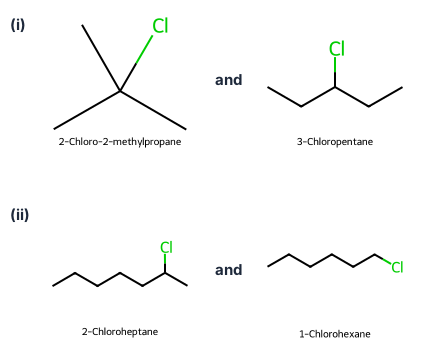
Q.In the following pairs of halogen compounds, which compound undergoes faster reaction?
You're viewing a preview — the full solution, concept, methods & PYQ mapping are locked.
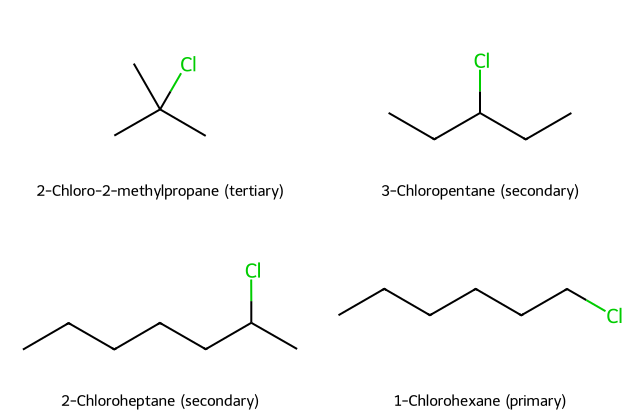
Start your 14-day free trial to unlock the full solution →The key idea is that reactions depend on carbocation stability. In (i), 2-chloro-2-methylpropane forms a tertiary carbocation and reacts faster; in (ii), 2-chloroheptane forms a secondary carbocation while 1-chlorohexane forms a primary carbocation, so 2-chloroheptane reacts faster.
Understanding Reactivity
The (substitution nucleophilic unimolecular) reaction proceeds through a two-step mechanism where the rate-determining step is the formation of a carbocation intermediate. The rate depends only on the concentration of the substrate (the halogen compound), not on the nucleophile. This means the stability of the carbocation that forms is the single most important factor controlling how fast the reaction goes.
Carbocation stability follows a clear hierarchy: tertiary > secondary > primary > methyl. This is because alkyl groups are electron-donating through hyperconjugation and the inductive effect, which stabilise the positive charge on the carbon. More alkyl groups attached to the carbocation centre mean more stabilisation.
A common mistake is to confuse with reactivity. In , steric hindrance slows down the reaction for bulky substrates. In , the opposite is true — more alkyl groups (more bulk) actually help because they stabilise the carbocation. Always check which mechanism is being asked about.
Let us now apply this principle to each pair.
Pair (i): 2-Chloro-2-methylpropane vs 3-chloropentane
Step 1: Identify the carbocation each compound would form.
2-Chloro-2-methylpropane, , has the chlorine attached to a carbon that is bonded to three methyl groups. When the C–Cl bond breaks heterolytically, the carbon loses the chlorine and becomes a tertiary carbocation: .
3-Chloropentane, , has the chlorine on the middle carbon of a pentane chain. That carbon is bonded to two ethyl groups (each ) and one hydrogen. When the chlorine leaves, we get a secondary carbocation: .
Step 2: Compare carbocation stabilities.
A tertiary carbocation is significantly more stable than a secondary carbocation. The three alkyl groups in the tertiary carbocation provide more hyperconjugative structures and greater inductive electron donation than the two alkyl groups in the secondary carbocation.
Step 3: Relate stability to reaction rate.
Since the rate of depends on how easily the carbocation forms, the compound that gives the more stable carbocation will react faster. Therefore, 2-chloro-2-methylpropane undergoes reaction faster than 3-chloropentane.
A quick way to remember: for , "more substituted = faster". The carbon bearing the leaving group should have as many alkyl groups as possible. Here, tertiary beats secondary every time.
Pair (ii): 2-Chloroheptane vs 1-chlorohexane
Step 1: Identify the carbocation each compound would form. …
Unlock everything free for 14 days
- Full step-by-step solutions
- Concept-first explanations
- Methods, shortcuts & mistakes
- PYQ mapping + timed mock tests
Full access for 14 days. No credit card required.