Q.Find the area enclosed by the circle
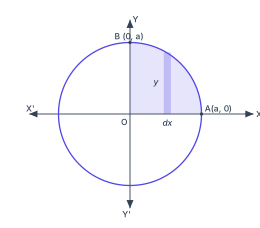
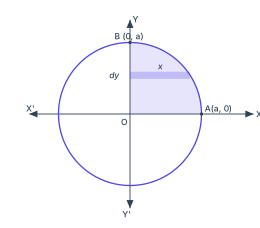
The area enclosed by the circle is found by integrating the upper semicircle from to and doubling. The result is .
The problem asks for the area inside a circle of radius centered at the origin. This is a classic result, but deriving it from first principles using integration is a great way to build intuition for how area works in Cartesian coordinates.
The equation describes a circle. If you solve for , you get . The positive square root gives the upper half of the circle; the negative gives the lower half. The circle is symmetric about the -axis, so the total area is twice the area of the upper half.
The key idea: the area under a curve from to is . Here, the upper semicircle runs from to . So the area of the upper half is . The total area is twice that.
- Set up the integral for the total area. The total area is:
The integrand is an even function (symmetric about ), so we can simplify:
This avoids dealing with negative limits.
-
Use a trigonometric substitution.
The expression suggests the substitution . Why? Because , which is simpler.
When , . When , . Also, .
Substitute into the integral:
- Evaluate the integral. Use the identity :
Integrate term by term:
So:
A faster way: the area of a circle is . Here , so the answer is directly. The integration above confirms this geometrically obvious result.
A common mistake is to forget the factor of 2 when doubling the semicircle area, or to incorrectly handle the limits after substitution. Always check that the substitution's limits match the original variable's range.
The area enclosed by the circle is .
Unlock everything free for 14 days
- Full step-by-step solutions
- Concept-first explanations
- Methods, shortcuts & mistakes
- PYQ mapping + timed mock tests
Full access for 14 days. No credit card required.