Q.(i) What will be de-Broglie wavelength associated with-
🔒You're viewing a preview — the full solution, concept, methods & PYQ mapping are locked.
🔒 Start your 14-day free trial to unlock the full solution →Concept understanding — De Broglie Wavelength
De Broglie Wavelength: When Particles Start Acting Like Waves
Imagine you're holding a cricket ball. You know exactly where it is, and if you throw it, you can predict its path. That's a particle — localised, definite, following Newton's laws. Now think of light. You can't "hold" a beam of light; it spreads out, bends around corners, creates interference patterns. That's a wave — spread out, not localised.
For centuries, physics kept these two worlds separate. Particles were particles. Waves were waves. Never the twain shall meet.
Then came a young French physicist, Louis de Broglie, in 1924. He asked a question that seemed almost absurd: If light — which we thought was a wave — can behave like a particle (the photoelectric effect), then why can't a particle — say, an electron — behave like a wave?
That question turned physics upside down.
The Core Idea
De Broglie proposed that every moving particle has a wave associated with it. The wavelength of that wave depends on the particle's momentum. The faster or heavier the particle, the shorter the wavelength.
λ=ph=mvh
Where:
- λ = de Broglie wavelength (in metres)
- h = Planck's constant (6.626×10⁻³⁴ J⋅s)
- p = momentum of the particle (mv for non-relativistic speeds)
This is not a mathematical trick. It's a physical reality. An electron moving through a crystal actually behaves like a wave of this wavelength — it can diffract, interfere, and form patterns just like light does.
Why You Don't See It in Daily Life
Here's the crucial point: the de Broglie wavelength is incredibly tiny for everyday objects.
Take a cricket ball of mass 0.16 kg moving at 30 m/s. Its de Broglie wavelength is:
λ=0.16×306.626×10−34≈1.38×10⁻³⁴ m
That's about a hundred trillion trillion times smaller than the nucleus of an atom. No experiment can detect such a wave — it's effectively zero for all practical purposes.
Now take an electron (mass 9.1×10⁻³¹ kg) accelerated through 100 volts. Its speed is about 5.9×10⁶ m/s. Its de Broglie wavelength:
λ=9.1×10−31×5.9×1066.626×10−34≈1.23×10⁻¹⁰ m
That's about 0.12 nanometres — comparable to the spacing between atoms in a crystal. This is measurable. And indeed, in 1927, Davisson and Germer fired electrons at a nickel crystal and observed diffraction — the unmistakable signature of a wave.
The de Broglie wavelength is only observable when it is comparable to the size of objects the particle interacts with. For macroscopic objects, it's far too small to matter. For subatomic particles, it's the key to understanding their behaviour.
What This Means Physically
The wave is not a physical wave in space like a water wave. It's a probability wave — its amplitude at any point tells you the probability of finding the particle there. Where the wave amplitude is large, you're likely to find the particle; where it's zero, you won't.
This wave-particle duality is not a compromise. It's the actual nature of reality. An electron is neither a pure particle nor a pure wave — it's something that shows particle-like behaviour in some experiments (like hitting a screen at a point) and wave-like behaviour in others (like passing through two slits and interfering with itself). …
Why this formula?
De Broglie Wavelength: Why the Formula Holds
Let's build this from the ground up — understanding why matter has a wavelength, not just memorizing λ=ph.
The Core Insight: Nature's Symmetry
Before de Broglie, physics had two separate worlds:
- Light — showed wave behaviour (diffraction, interference) but also particle behaviour (photoelectric effect)
- Matter — showed particle behaviour (momentum, collisions) but no wave behaviour yet
De Broglie asked a daring question in his 1924 PhD thesis:
If light (a wave) can behave like a particle, why can't a particle (like an electron) behave like a wave?
Nature should be symmetric — what applies to one should apply to the other.
Step 1: Start with Light (What We Already Knew)
For a photon, Einstein had given us two key relations:
- Energy: E=hf (Planck's relation)
- Momentum: p=λh (from E=pc for light, combined with c=fλ)
So for light:
λ=ph
This was experimentally verified for photons.
Step 2: De Broglie's Bold Hypothesis
De Broglie said: This relation is not special to light. It is universal.
For any particle with momentum p:
λ=ph
Where:
- λ = de Broglie wavelength
- h = Planck's constant (6.626×10⁻³⁴ J⋅s)
- p = momentum of the particle
Step 3: Why Momentum and Not Velocity?
This is crucial. The formula uses momentum (p=mv), not just velocity.
For a non-relativistic particle (slow compared to light):
λ=mvh
For a relativistic particle (like an electron at high speed):
p=γmvwhereγ=1−v2/c21
λ=γmvh
Why momentum? Because momentum is the more fundamental quantity — it's conserved, it's frame-independent in a deeper sense, and it connects directly to the wave's phase.
Step 4: The Deeper Reasoning — Wave-Particle Duality
De Broglie didn't just guess. He reasoned:
- Every moving particle has an associated wave — called the "matter wave" or "pilot wave"
- The frequency of this wave comes from energy: f=hE
- The wavelength comes from momentum: λ=ph
These two relations are linked by the phase velocity of the wave:
vphase=fλ=hE⋅ph=pE
For a free particle with kinetic energy E=2mp2:
vphase=2mp=2v
This is half the particle's speed — a strange but mathematically consistent result.
Step 5: Experimental Confirmation (Why We Believe It)
De Broglie's idea was confirmed when electrons showed wave behaviour: …
A particle's de Broglie wavelength is Planck's constant divided by its momentum, so it is appreciable only when the mass is tiny, as for an electron, and utterly negligible for an everyday object. Comparing the two cases below shows why only microscopic particles reveal wave behaviour. …
de Broglie wavelength λ=h/(mv) is appreciable only for particles of very small mass, like electrons; for macroscopic masses it is utterly negligible.
(i)(a) Electron: me=9.1×10⁻³¹ kg, v=5.4×10⁶ m/s, h=6.6×10⁻³⁴ Js.
λ=mvh=(9.1×10⁻³¹)(5.4×10⁶)6.6×10−34=4.914×10−246.6×10⁻³⁴≈1.34×10⁻¹⁰ m (≈1.34 A˚)
(i)(b) Ball: m=150 gm=0.150 kg, v=30 m/s.
λ=mvh=(0.150)(30)6.6×10−34=4.56.6×10−34≈1.47×10⁻³⁴ m
(ii) Macroscopic objects do not show observable wave-like properties because their mass m is enormously large compared to atomic particles, so their de Broglie wavelength λ=h/(mv) (as computed above, ∼10−34 m for an everyday-sized object) is far smaller than any length that could ever be measured or that could produce observable diffraction/interference effects — hence their wave nature is completely masked, and they appear to obey purely classical (particle) mechanics.
OR (alternative) — nuclear force:
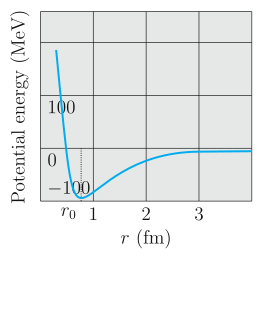
Two characteristic properties of the nuclear force: (1) it is a short-range force, effectively zero beyond a separation of about 3–4 fm (unlike gravitational or Coulomb forces which act over unlimited range); (2) it is charge-independent — the force between two protons, two neutrons, or a proton and a neutron is approximately the same, regardless of their charge.
…
Showing the 12 most recent of 70 on this concept.
- CBSE 2026Set 55/1/11 markMCQQ.For questions 13 to 16, two statements are given – one labelled Assertion (A) and the other labelled Reason (R). Select the correct answer from the codes (A), (B), (C) and (D) below: (A) Both Assertion (A) and Reason (R) are true and Reason (R) is the correct explanation of the Assertion (A). (B) Both Assertion (A) and Reason (R) are true, but Reason (R) is not the correct explanation of the Assertion (A). (C) Assertion (A) is true, but Reason (R) is false. (D) Both Assertion (A) and Reason (R) are false. Assertion (A) : If accelerated electrons are passed through a narrow slit, a diffraction pattern is observed. Reason (R) : Electrons behave as both particles and waves.
›Reveal solutionSolution
Electrons exhibit wave-particle duality; their wave nature (de Broglie wavelength) causes diffraction when passing through narrow slits, just like light waves. Both statements are true, and the Reason correctly explains the Assertion.
Understanding Wave-Particle Duality
The heart of this question lies in one of quantum mechanics' most profound insights: matter at the atomic scale doesn't fit neatly into our classical categories of "particle" or "wave." Louis de Broglie proposed in 1924 that every moving particle has an associated wavelength, given by
λ=ph=mvh
where h is Planck's constant, p is momentum, m is mass, and v is velocity.
When we accelerate electrons, we increase their momentum. Yet even at high speeds, electrons retain a measurable de Broglie wavelength—typically on the order of angstroms for electrons accelerated through a few hundred volts. This wavelength is comparable to the spacing between atoms in crystals or the width of carefully engineered slits.
Examining the Assertion
Assertion (A): If accelerated electrons are passed through a narrow slit, a diffraction pattern is observed.
This is experimentally verified and true. The classic demonstration is the Davisson-Germer experiment (1927), which showed electron diffraction from crystal lattices. More dramatically, modern versions of the double-slit experiment with electrons—sending them one at a time—build up an interference pattern on a detector screen over time.
Diffraction occurs when waves encounter obstacles or apertures comparable to their wavelength. The electron beam, despite being composed of particles with mass and charge, produces the characteristic bright and dark fringes we associate with wave phenomena. The central maximum, secondary maxima, and minima all appear exactly as wave theory predicts.
For single-slit diffraction, minima occur at angles θ satisfying:
asinθ=nλ
where a is the slit width, n=1,2,3,…, and λ is the de Broglie wavelength.
Examining the Reason
Reason (R): Electrons behave as both particles and waves.
This is the principle of wave-particle duality, a cornerstone of quantum mechanics. It is unequivocally true.
Electrons exhibit particle properties: they have definite mass (9.11×10⁻³¹ kg), charge (−1.6×10⁻¹⁹ C), and produce localized impacts on detectors (you can count individual electron arrivals). Simultaneously, they exhibit wave properties: they diffract, interfere, and possess a wavelength and frequency.
Neither description alone is complete. The electron is a quantum object, and which aspect we observe depends on the experimental setup. When we look for particle behavior (measuring position or momentum), we find particles. When we create conditions for wave behavior (slits, crystals), we observe diffraction and interference. …
- CBSE 2026Set 55/3/11 markMCQQ.A proton and an alpha particle have equal momentum. The ratio of their kinetic energies (EαEp) and the ratio of the de Broglie wavelengths associated with them (λαλp) respectively are : (A) 2, 1 (B) 1, 2 (C) 4, 1 (D) 1, 4
›Reveal solutionSolution
For equal momentum, kinetic energy is inversely proportional to mass, and de Broglie wavelength is directly proportional to mass. Since the alpha particle has 4 times the mass of a proton, the ratio of kinetic energies is 4:1 and the ratio of wavelengths is 1:1. The correct option is (C).
The key to this problem lies in two fundamental relationships: the de Broglie wavelength and the connection between kinetic energy and momentum. When two particles have the same momentum, their de Broglie wavelengths become equal — that part is immediate. The kinetic energy, however, depends on mass because Ek=p2/2m, so the lighter particle has more kinetic energy.
Let’s work through it systematically.
-
Recall the de Broglie wavelength formula.
Every moving particle has a wavelength associated with it, given by λ=ph, where h is Planck’s constant and p is the linear momentum. This is a direct consequence of wave-particle duality — the more momentum a particle has, the shorter its wavelength.
Since the problem states that the proton and alpha particle have equal momentum, we can write:
pp=pα
Therefore:
λp=pphandλα=pαh
Because pp=pα, the two wavelengths are identical:
λαλp=1
- Now find the kinetic energy ratio. Kinetic energy is related to momentum by:
Ek=2mp2
This comes from combining Ek=21mv2 with p=mv. For equal momentum, the kinetic energy is inversely proportional to mass — a heavier particle moving with the same momentum must be slower, so it has less kinetic energy.
For the proton (mass mp) and alpha particle (mass mα):
EαEp=p2/2mαp2/2mp=mpmα
- Know the masses involved. …
-
- CBSE 2026Set V11 markMCQQ.An α-particle, a proton, an electron and a neutron are moving with the same velocity. Then the particle having longest de Broglie wavelength is :(a) proton(b) electron(c) neutron(d) α-particle
›Reveal solutionSolution
(b) electron …
- CBSE 2026Set A1 markMCQQ.The ratio of de Broglie wavelength associated with two electrons accelerated through 49 V and 64 V is (A) 49/64 (B) 64/49 (C) 7/8 (D) 8/7
›Reveal solutionSolution
de Broglie wavelength of an accelerated electron λ ∝ 1/√V; ratio = √(64/49) = 8/7.
For an electron accelerated through potential difference V, its kinetic energy is eV=2mp2, so p=2meV and the de Broglie wavelength is
λ=2meVh∝V1.
Hence …
- CBSE 2026Set ANNUAL1 markMCQQ.If alpha particle, proton and electron move with the same momentum, then their respective de Broglie wavelengths λα, λp, λe are related as(a) λα > λp > λe(b) λα < λp < λe(c) λα = λp = λe(d) None of the above
›Reveal solutionSolution
Equal momentum means equal de Broglie wavelength, regardless of the particles' different masses.
The de Broglie wavelength of a particle is
λ=ph
where h is Planck's constant and p is the particle's momentum. This formula depends only on momentum p, not on the particle's mass, charge, or identity. Since the alpha particle, proton and electron are all stated to have the same momentum, they must all have the …
- CBSE 2026Set ANNUAL1 markQ.A body of mass 0.10 kg is moving with a speed of 10 m/s. The de-Broglie wavelength of the wave associated with it will be ______ m.
›Reveal solutionSolution
The de Broglie wavelength of a moving body is lambda = h/(mv); plugging in the mass and speed gives the value directly.
De Broglie's relation: lambda = h / (m v), where h = 6.63 x 10^-34 J.s (Planck's constant), m = 0.10 kg, v = 10 m/s. …
- CBSE 2025Set 55/4/11 markMCQQ.Choose the correct statement: (A) Photons of light show diffraction whereas electrons do not show diffraction. (B) Electrons have momentum whereas photons do not have momentum. (C) Photons of light and electrons both exhibit dual nature. (D) All electromagnetic radiations do not have photons.
›Reveal solutionSolution
Both photons and electrons exhibit wave-particle duality — the key idea is that both show diffraction (wave behaviour) and carry momentum (particle behaviour). The correct statement is (C).
Concept First: De Broglie Wavelength and Dual Nature
The entire foundation of modern quantum mechanics rests on wave-particle duality — the idea that every moving particle has a wavelength associated with it. Louis de Broglie proposed this in 1924, and it’s summarised by:
λ=ph
where λ is the de Broglie wavelength, h is Planck’s constant, and p is the momentum.
This means:
- Photons (light quanta) have momentum p=λh and show wave phenomena like diffraction and interference.
- Electrons (particles with mass) also have a de Broglie wavelength λ=mvh and therefore do show diffraction — this was famously confirmed by Davisson and Germer in 1927.
So both photons and electrons possess both wave-like and particle-like properties. That is the dual nature.
Step-by-Step Analysis
1. Statement (A): “Photons of light show diffraction whereas electrons do not show diffraction.”
This is false. Electrons do show diffraction — the Davisson–Germer experiment proved it. In fact, electron diffraction is routinely used in techniques like transmission electron microscopy (TEM). The wavelength of an electron can be tuned by changing its accelerating voltage, making it a practical tool.
Watch outA common mistake is to think diffraction is only for light. In reality, any particle with a de Broglie wavelength comparable to the slit spacing will diffract — electrons, neutrons, even large molecules like buckyballs have been shown to diffract.
2. Statement (B): “Electrons have momentum whereas photons do not have momentum.” …
- CBSE 2025Set 55/5/11 markMCQQ.The kinetic energy of an alpha particle is four times the kinetic energy of a proton. The ratio λpλα of the de Broglie wavelengths associated with them will be: (A) 161 (B) 81 (C) 41 (D) 21
›Reveal solutionSolution
The de Broglie wavelength depends on momentum, not directly on kinetic energy. Using K=2mp2 and the given Kα=4Kp, along with mα=4mp, we find λpλα=41, which corresponds to option (C).
The de Broglie wavelength is the bridge between particle and wave behaviour: λ=ph, where h is Planck’s constant and p is the momentum. The problem gives you kinetic energy, not momentum directly — so the first step is always to connect K and p.
For any non-relativistic particle, kinetic energy is K=2mp2. Rearranging, p=2mK. This is the key relation that lets you translate the given energy ratio into a wavelength ratio.
-
Write the wavelength for each particle.
For the alpha particle: λα=pαh=2mαKαh.
For the proton: λp=pph=2mpKph.
-
Take the ratio.
λpλα=h/2mpKph/2mαKα=mαKαmpKp.
Notice that h and the factor 2 cancel out neatly.
-
Plug in the given data.
You are told Kα=4Kp. Also, an alpha particle is a helium nucleus — 2 protons and 2 neutrons — so its mass is approximately 4 times the proton mass: mα=4mp.
Substitute:
λpλα=(4mp)⋅(4Kp)mp⋅Kp=161=41. …
-
- CBSE 2025Set X11 markMCQQ.A ball is dropped from a certain height and it falls freely under gravity. During the fall, the de Broglie wavelength associated with it :(a) keeps increasing(b) keeps decreasing(c) is zero(d) may increase or decrease
›Reveal solutionSolution
(b) keeps decreasing. The de Broglie wavelength is λ=mvh. As the ball falls freely, its speed v increases continuously, so λ (inversely proportional to v) keeps dec …
- CBSE 2025Set D1 markMCQQ.The wavelength of de Broglie wave associated with any moving particle does not depend on (A) mass (B) charge (C) velocity (D) momentum
›Reveal solutionSolution
λ = h/p = h/mv, so it depends on mass, velocity and momentum — charge does not appear in the formula.
The de Broglie wavelength of a moving particle is
λ = h/p = h/(mv)
where h is Planck's constant, m the mass, v the velocity and p = mv the momentum. The formula contains mass, velocity and momentum, so the wavelength depends on all three.
…
- CBSE 2025Set A1 markQ.Match Column 'A' item 'Matter waves' with the correct option from Column 'B' and write the correct pair. Column 'B' options:(i) Minimum energy to emit electrons from the surface(ii) Minimum frequency to emit electrons from the surface(iii) Frequency of photon(iv) Number of photons(v) Moving particle(vi) Photon(vii) Einstein.
›Reveal solutionSolution
Matter waves correspond to option (v): a moving particle.
Louis de Broglie proposed that, just as light exhibits both wave and particle nature, every moving material particle (electron, proton, or even a macroscopic object) has a wave associated with it, called the matter wave (or de Broglie wave), with wavelength λ=h/p, where p is the particle's momentum. This concept applies specifically to a moving particle — a particle at rest (p = 0) has an undef …
- CBSE 2025Set ANNUAL1 markMCQQ.Which of the following has the longest de-Broglie wavelength, if they are moving with same velocity ?(a) proton(b) neutron(c) α-particle(d) β-particle
›Reveal solutionSolution
At a common velocity, the lightest particle has the longest de Broglie wavelength.
The de Broglie wavelength is
λ=mvh
For a fixed velocity v (and fixed h), λ∝1/m — the smaller the mass, the longer the wavelength.
…
🎓Unlock everything free for 14 days
- ✓Full step-by-step solutions
- ✓Concept-first explanations
- ✓Methods, shortcuts & mistakes
- ✓PYQ mapping + timed mock tests
Full access for 14 days. No credit card required.