Physics · Ch 6 — Electromagnetic Induction
Lenz's Law and Conservation of Energy
Lenz's Law and Conservation of Energy
Lenz’s Law: The Direction of Induced EMF
Lenz’s law gives the polarity of the induced emf. It states:
The polarity of induced emf is such that it tends to produce a current which opposes the change in magnetic flux that produced it.
This opposition is the physical reason for the negative sign in Faraday’s law:
Here:
- is the induced emf (in volts).
- is the magnetic flux (in webers).
- The negative sign embodies Lenz’s law.
How Lenz’s Law Works (Using a Bar Magnet and Coil)
Consider a bar magnet’s North pole approaching a closed coil:
- Flux increases through the coil.
- To oppose this increase, the induced current must create its own magnetic field that repels the approaching North pole.
- This requires the induced current to flow counter-clockwise (as seen from the magnet’s side), producing a North pole on the coil’s face facing the magnet.
Now, if the North pole is withdrawn:
- Flux decreases through the coil.
- To oppose this decrease, the induced current must create a field that attracts the receding North pole.
- This requires the induced current to flow clockwise, producing a South pole on the coil’s face facing the magnet.
Why Lenz’s Law is a Consequence of Energy Conservation
If the induced current flowed in the opposite direction (e.g., attracting the approaching magnet), the magnet would accelerate without any work being done. This would create a perpetual motion machine, violating the law of conservation of energy.
In reality:
- The induced current produces a repulsive force when flux increases, and an attractive force when flux decreases.
- The person moving the magnet must do work against this force.
- This work is converted into Joule heating () in the coil.
Thus, Lenz’s law ensures that energy is conserved.
Determining Direction of Induced Current Using Lenz’s Law
For a loop moving into or out of a magnetic field:
- Loop entering field: Flux increases. Induced current flows to create a field opposing the external field (i.e., repelling the loop).
- Loop leaving field: Flux decreases. Induced current flows to create a field supporting the external field (i.e., attracting the loop).
Example 6.4 (Figure 6.7):
- (i) Rectangular loop entering field: current along bcdab.
- (ii) Triangular loop leaving field: current along bacb.
- (iii) Irregular loop leaving field: current along cdabc.
Key point: No induced current when the loop is completely inside or completely outside the field region.
Special Cases (Example 6.5)
(a) A stationary loop in a strong, steady magnetic field: No induced current — flux is constant. …
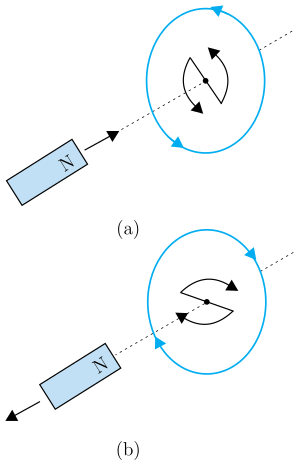
Drawn by us to help you understand the concept clearly, and verified to make sure it's accurate. For exams, practice from your textbook's own diagram.
What the Figure Shows
The figure has two panels, (a) and (b), each showing a circular wire loop (drawn as an ellipse) on the upper-right and a bar magnet on the lower-left. The magnet’s North pole (labelled N) faces the loop. A dashed axis with an arrowhead connects the magnet and loop, indicating the direction of motion. A curved arrow on the loop shows the direction of the induced current.
- Panel (a): The North pole is approaching the loop (motion arrow toward the loop). The induced current is counter-clockwise when viewed from the magnet’s side.
- Panel (b): The North pole is receding from the loop (motion arrow away from the loop). The induced current is clockwise when viewed from the magnet’s side.
The Physical Idea: Lenz’s Law
Lenz’s law states that the induced current always flows in a direction that opposes the change in magnetic flux that produced it. This is the physical meaning of the negative sign in Faraday’s law:
where is the induced emf and is the magnetic flux through the loop.
- When the North pole approaches (panel a): The magnetic flux through the loop increases. To oppose this increase, the induced current creates its own magnetic field with a North pole facing the approaching magnet. This repels the magnet, opposing the motion. The current must be counter-clockwise (from the magnet’s side) to produce that North pole.
- When the North pole recedes (panel b): The magnetic flux decreases. To oppose this decrease, the induced current creates a South pole facing the receding North pole, attracting the magnet and opposing its withdrawal. The current must be clockwise (from the magnet’s side) to produce that South pole.