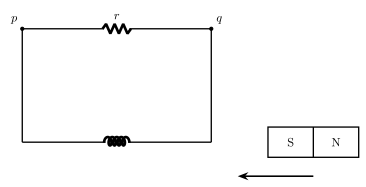
Q.What will be the direction of the induced current in the situation shown in the following figure?
You're viewing a preview — the full solution, concept, methods & PYQ mapping are locked.
Start your 14-day free trial to unlock the full solution →Concept understanding — Lenz's Law
Statement. Lenz's law, formulated by the German physicist Heinrich Lenz, gives the DIRECTION of an induced current (which Faraday's laws alone do not specify): the direction of the induced current is always such that it opposes the cause responsible for its production. If a changing flux is the cause and an induced current the effect, the induced current always acts, through the magnetic field it itself creates, to oppose that very flux change.
In the emf formula. Incorporating Lenz's law into Faraday's law supplies the standard minus sign, -- not a mathematical formality, but a literal encoding of the physical statement that the induced emf's polarity always opposes the flux change producing it.
Application technique. To find a direction: (i) determine whether the relevant flux is increasing or decreasing; (ii) the induced current flows in whichever sense creates its OWN magnetic field that opposes that particular change (reinforcing a decreasing flux, or counteracting an increasing one); (iii) apply the right-hand rule to that self-field to read off the current's actual direction around the loop. Equivalently, for a magnet approaching/receding a coil, the coil's near end becomes whichever pole (N or S) repels an approaching magnet or attracts a receding one. …
Unlock everything free for 14 days
- Full step-by-step solutions
- Concept-first explanations
- Methods, shortcuts & mistakes
- PYQ mapping + timed mock tests
Full access for 14 days. No credit card required.