Physics · Ch 2 — Electrostatic Potential and Capacitance
Potential Energy of a Dipole in an External Field
Potential Energy of a Dipole in an External Field
Potential Energy of a Dipole in an External Field
When an electric dipole (charges and separated by distance ) is placed in a uniform external electric field , it experiences no net force but a torque . This torque tends to rotate the dipole to align with the field. To change its orientation, an external torque must do work against this torque. This work is stored as potential energy of the dipole in the field.
Work Done by External Torque
- Let the dipole be rotated from an initial angle to a final angle (measured from the direction of ) at an infinitesimal speed (no angular acceleration).
- The external torque exactly cancels the electric torque at every step.
- The work done by the external torque is:
This work is stored as the change in potential energy of the system.
Defining Potential Energy
- We can associate a potential energy with the dipole's orientation.
- There is a freedom to choose a reference angle where . A natural choice is (dipole perpendicular to the field). Why? At , the work done in bringing and from infinity to their positions against the field cancels out, making the constant term zero.
- With this choice, the potential energy at any angle is:
- : magnitude of dipole moment ()
- : magnitude of uniform electric field
- : angle between and
Alternative Derivation Using Potential Energy of Two Charges
- For two charges and at positions and , the potential energy in an external field is:
where is the electrostatic potential due to the external field.
- For a uniform field , the potential difference between the two charges is:
- Substituting: …
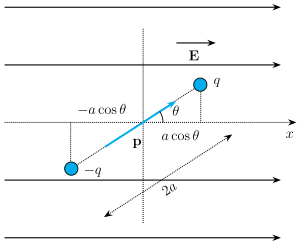
Drawn by us to help you understand the concept clearly, and verified to make sure it's accurate. For exams, practice from your textbook's own diagram.
The figure shows a dipole (two charges and separated by a distance ) placed in a uniform external electric field . The field is represented by long, horizontal, parallel lines with rightward arrowheads, and a bold arrow near the top labelled indicates the field direction (to the right).
The dipole itself is drawn as a bold arrow from the lower-left charge () to the upper-right charge (). The dipole moment vector points from to , and its magnitude is .
A horizontal dashed reference line passes through the midpoint of the dipole. The angle is the acute angle between the dipole moment and the horizontal (i.e., the direction of ). A vertical dashed line drops from to the horizontal reference line. The horizontal distance from this vertical line to the right is labelled , and to the left is labelled . This shows that the projection of the dipole arm along the field direction is .
Physical idea: In a uniform field, the dipole experiences no net force but a torque that tends to align it with the field. The figure helps visualise the work done by an external torque to rotate the dipole from an initial angle to a final angle , which is stored as potential energy.
Key formula developed from this figure:
The potential energy of a dipole in a uniform external field is:
where:
- is the magnitude of the dipole moment,
- is the magnitude of the uniform electric field,
- is the angle between and , …