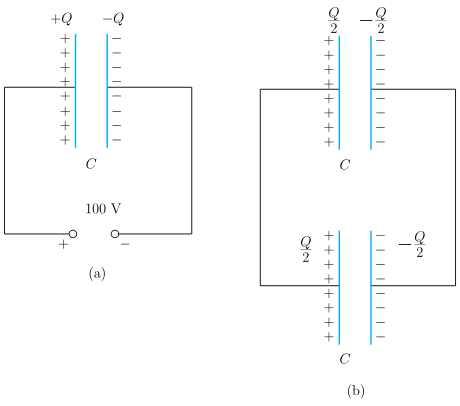
Q.(a) A capacitor is charged by battery [Fig. 2.31(a)]. How much electrostatic energy is stored by the capacitor?
You're viewing a preview — the full solution, concept, methods & PYQ mapping are locked.
Start your 14-day free trial to unlock the full solution →Energy stored in a charged capacitor is . Charging to stores (part a). Once disconnected from the battery and connected to an identical uncharged capacitor, the fixed total charge splits equally between the two (now-parallel) capacitors, and the system's total stored energy drops to exactly half, (part b) — the rest is dissipated as heat/spark during the redistribution.
Part (a): energy stored while connected to the battery
Using :
The charge on the capacitor at this point is — this is the charge carried over into part (b).
Part (b): disconnect, then connect to an identical uncharged capacitor
Once the battery is removed, the charge on the first capacitor is fixed (nothing left to add or remove charge). Connecting it to a second, identical, uncharged capacitor puts the two in parallel, and since there is no external source, the total charge must simply redistribute between them.
By symmetry (identical capacitors), the charge splits equally:
The combined (parallel) capacitance is , and the total stored energy afterward is …
Unlock everything free for 14 days
- Full step-by-step solutions
- Concept-first explanations
- Methods, shortcuts & mistakes
- PYQ mapping + timed mock tests
Full access for 14 days. No credit card required.