Physics · Ch 2 — Electrostatic Potential and Capacitance
Relation Between Field and Potential
Relation Between Field and Potential
Why This Relation Matters
The electric field and potential are not independent — they describe the same electrostatic situation from different angles.
The field tells you the force per unit charge at a point; the potential tells you the work per unit charge to bring a charge from infinity.
The link between them is derivative: the field is the negative gradient of the potential.
Step-by-Step Derivation
-
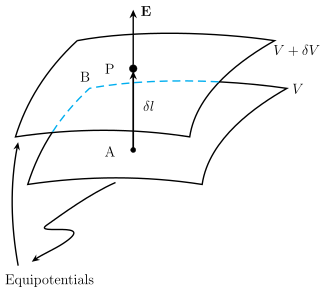
Set up two close equipotential surfaces
- Surface A has potential .
- Surface B has potential , where is the small change in potential in the direction of the electric field .
- Let be a point on surface B.
- The perpendicular distance from surface A to point is .
-
Move a unit positive charge
- Imagine moving a unit positive charge from surface B to surface A against the electric field, along the perpendicular .
- Work done by an external agent = force distance = (since force on unit charge = ).
-
Relate work to potential difference
- Work done = potential difference .
- Here and .
- So:
- Solve for magnitude of field
- Rearranging:
This is **Equation (2.20)** in the textbook.
5. Interpret the negative sign
- is negative because potential decreases in the direction of .
- Write , then:
So magnitude of field = **rate of change of potential** along the perpendicular to the equipotential surface.
6. Vector form
- The field points in the direction of steepest decrease of potential.
- In one dimension:
In three dimensions (gradient form): …
Drawn by us to help you understand the concept clearly, and verified to make sure it's accurate. For exams, practice from your textbook's own diagram.
The figure shows two closely spaced curved surfaces, one above the other. The lower surface is labelled A and has potential V. The upper surface is labelled B and has potential V + δV. These surfaces are equipotentials — every point on a given surface is at the same electric potential.
A point P is marked on the upper surface B. A straight vertical arrow rises from P, pointing upward, and is labelled E at its top. This arrow represents the electric field vector at point P. The field is perpendicular to the equipotential surface B and points in the direction of decreasing potential (from higher to lower potential). Since the potential on B is higher than on A (V + δV > V), the field points away from B, toward the region of lower potential.
A short vertical segment between the two surfaces is labelled Δl. This is the perpendicular distance from point P on surface B down to surface A. Because the surfaces are equipotentials, the shortest path between them is along the normal (perpendicular) direction — and that is exactly the direction of the electric field.
At the right edge of the figure, the upper sheet is tagged 'V + δV' and the lower sheet 'V'. A wavy bracket below points to the word 'Equipotentials', indicating that both surfaces are equipotential surfaces.
Physical idea
The figure illustrates the fundamental relation between electric field and potential: the electric field points in the direction of the steepest decrease of potential, and its magnitude equals the rate of change of potential with distance along the normal to the equipotential surface.
Key formula derived from the figure
The textbook derives:
where:
- is the magnitude of the electric field at point P.
- is the change in potential between the two surfaces (here, , but note that is positive while the potential decreases in the direction of , so the change in potential in that direction is ).
- is the perpendicular distance between the equipotential surfaces (the gap A → P).
The negative sign indicates that the electric field points opposite to the direction of increasing potential. Since is positive and the field points from higher to lower potential, the actual potential difference in the field direction is , giving: …