Q.Focal length of each lens shown in the figure below is 10 cm. Find the distance of the final image of point object O from the convex lens. Draw the ray diagram also. [FIGURE: A point object O lies on the principal axis, 20 cm to the left of a convex (double-convex) lens of focal length 10 cm. A second lens — biconcave (diverging), focal length 10 cm — is placed 30 cm to the right of the convex lens, on the same principal axis.]
You're viewing a preview — the full solution, concept, methods & PYQ mapping are locked.
Start your 14-day free trial to unlock the full solution →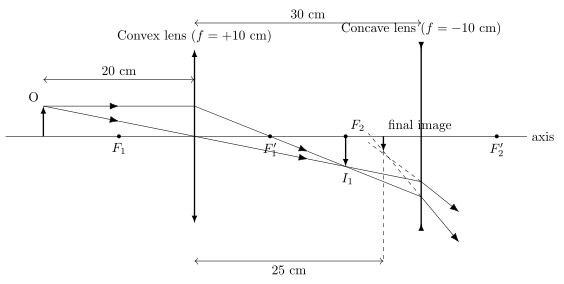
Apply the thin-lens formula twice in succession, treating the first lens's image as the object for the second.
Taking the direction of incident light as positive (standard Cartesian sign convention), with O placed 20 cm to the left of the convex lens (), and the concave lens () placed 30 cm further to the right.
Step 1 — Convex lens. Object distance , .
So the convex lens forms a real image 20 cm to its right.
Step 2 — Concave lens. The two lenses are 30 cm apart, and the first image lies 20 cm from the convex lens, i.e. before it reaches the concave lens. This (virtual object location relative to lens 1, but a real object for lens 2) gives object distance for the concave lens , with :
The negative sign means this final image is virtual, formed 5 cm to the left of the concave lens (on the same side as the light entering it).
Locating the final image relative to the convex lens: the concave lens is from O, i.e. to the right of the convex lens. The final image, 5 cm to the left of the concave lens, is therefore to the right of the convex lens.
…
Unlock everything free for 14 days
- Full step-by-step solutions
- Concept-first explanations
- Methods, shortcuts & mistakes
- PYQ mapping + timed mock tests
Full access for 14 days. No credit card required.