Skip to content
Question of 73

Q.Derive the formula to determine refractive index of the material of the prism and show that thin prisms do not deviate light much.

(OR)
A telescope has an objective lens of focal length 140 cm and an eyepiece of focal length 5.0 cm.
(i) What is the magnifying power of the telescope for viewing distant objects when-
(a) The telescope is in normal adjustment (i.e. when final image is at infinity).
(b) The final image is formed at the least distance of distinct vision (25 cm).
(ii) What is the separation between the objective lens and the eyepiece for normal adjustment?
(iii) If this telescope is used to view a 100 m tall tower 3 km away, what is the height of the image of the tower formed by the objective lens? [Note: in the source scan, sub-part (iii)'s text has a line struck through part of it; this may be a printing/scan artifact rather than an official deletion — transcribed and solved in full for completeness.]
Uttarakhand UbseUttarakhand Board Intermediate (Class 12) 2025Subjective· 4mImportance★★★★★
0% · 0/73 Questions
🔒 Locked · start free trial →

You're viewing a preview — the full solution, concept, methods & PYQ mapping are locked.

Start your 14-day free trial to unlock the full solution →

Prism formula relates refractive index to the prism angle and minimum deviation; for a thin prism the deviation reduces to δ=(μ−1)A\delta=(\mu-1)A, which is small.

Main question — refractive index of prism material:

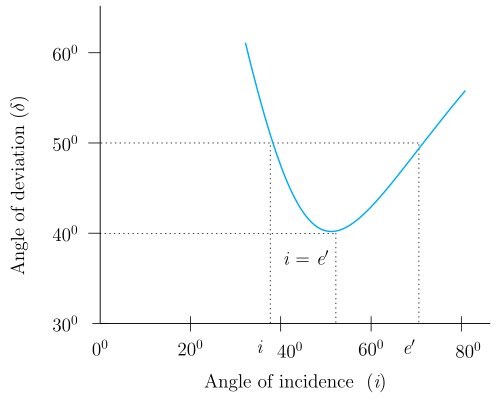
For a prism of angle AA, as the angle of incidence is varied, the angle of deviation δ\delta first decreases, reaches a minimum value δm\delta_m, and then increases. At minimum deviation, the ray inside the prism travels symmetrically (parallel to the base), so the angle of incidence equals the angle of emergence (i1=i2=ii_1=i_2=i) and the refraction angles are equal (r1=r2=rr_1=r_2=r), with

r1+r2=A⇒r=A2r_1+r_2 = A \quad\Rightarrow\quad r = \frac{A}{2}

and from δ=i1+i2−A\delta = i_1+i_2-A at minimum deviation, δm=2i−A⇒i=A+δm2\delta_m = 2i - A \Rightarrow i = \dfrac{A+\delta_m}{2}.

Applying Snell's law at the first surface, μ=sin⁡isin⁡r\mu = \dfrac{\sin i}{\sin r}:

μ=sin⁡ ⁣(A+δm2)sin⁡ ⁣(A2)\boxed{\mu = \frac{\sin\!\left(\dfrac{A+\delta_m}{2}\right)}{\sin\!\left(\dfrac{A}{2}\right)}}

Thin prisms do not deviate light much: For a thin prism, AA is small, and if the angle of incidence is also small, all the refraction angles (i1,r1,r2,i2i_1,r_1,r_2,i_2) are small, so sin⁡θ≈θ\sin\theta\approx\theta (in radians) can be used:

i1=μr1,i2=μr2i_1 = \mu r_1,\qquad i_2 = \mu r_2

Adding, and using r1+r2=Ar_1+r_2=A:

i1+i2=μ(r1+r2)=μAi_1+i_2 = \mu(r_1+r_2) = \mu A

Since δ=i1+i2−A\delta = i_1+i_2-A:

δ=μA−A=(μ−1)A\delta = \mu A - A = (\mu-1)A

Because AA is small, δ=(μ−1)A\delta=(\mu-1)A is also small (and, notably, independent of the angle of incidence for small angles) — this shows thin prisms produce only a small deviation.

OR (alternative) — telescope: fo=140f_o = 140 cm, fe=5.0f_e = 5.0 cm.

(i)(a) Normal adjustment (final image at infinity): M=fofe=1405=28M = \dfrac{f_o}{f_e} = \dfrac{140}{5} = 28. …

Unlock everything free for 14 days

  • Full step-by-step solutions
  • Concept-first explanations
  • Methods, shortcuts & mistakes
  • PYQ mapping + timed mock tests

Full access for 14 days. No credit card required.