Business Mathematics and Basic Statistics · Ch 5 — Theory of Sets — Introduction
Subset, Superset and Proper Subset
Subset, Superset and Proper Subset
A set is called a subset of a set — written — if every element of is also an element of . Formally,
When , we also say is a superset of , written .
Two useful facts follow immediately: every set is a subset of itself (, since every element of is trivially in ), and the empty set is a subset of every set ( for any , since it has no elements that could ever fail to be in ).
A set is a proper subset of — written — if and ; that is, every element of is in , but contains at least one element that does not. A worked example the syllabus itself points to: let and . Every natural number is a whole number, so ; but while , so , which makes — a proper subset.
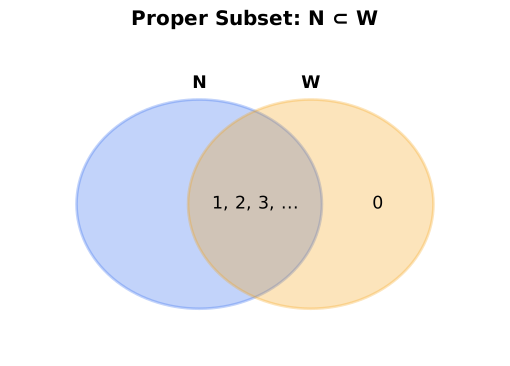
A point worth thinking about — does the relationship go both ways?
It is always true that — if is a proper subset of , it is certainly a subset of (proper subset is just a subset with the extra condition tacked on). For example, with and : is true, and indeed also holds.
…
is a subset of , written , if every element of is also an …
If , then is called a superset of , written $B …
is a proper subset of , written , if and — i.e. contains at least on …