Business Mathematics and Basic Statistics · Ch 6 — Trigonometry
Ratios of Standard Angles (0°, 30°, 45°, 60°, 90°)
Ratios of Standard Angles (0°, 30°, 45°, 60°, 90°)
Five angles — — appear so often in numerical work that their trigonometric ratios are worth memorising as a single reference table rather than recomputed from a triangle every time.
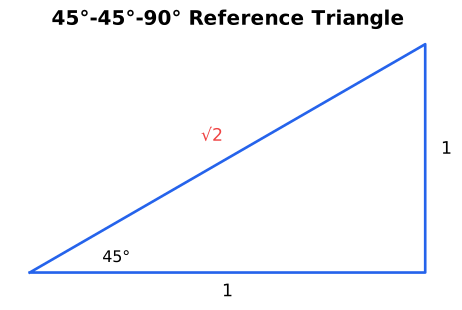
The angle comes from an isosceles right-angled triangle (a right triangle with both acute angles equal to ). If both legs are taken as length 1, the hypotenuse is by the Pythagorean theorem, giving and .
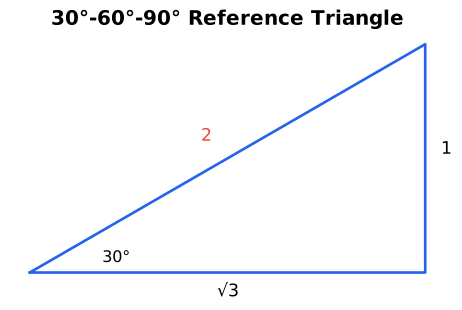
The and angles come from an equilateral triangle of side 2, split into two right triangles by an altitude. The altitude bisects the base and the apex angle, so each half-triangle has angles , a base of length 1, an altitude of , and a hypotenuse of 2 — giving , , , .
The and angles are the limiting cases as the angle in a right triangle shrinks to nothing or grows to fill the whole right angle; their ratios are read off directly ( and ), and , are undefined because they would require dividing by zero.
The Standard Angle Table
| undefined | |||||
| undefined | |||||
| undefined | |||||
| undefined | |||||
| … |