Physical Education · Ch 8 — Fundamentals of Kinesiology and Biomechanics in Sports
Plane
Plane
A plane is an imaginary flat surface that divides the body into two parts. There are three planes of motion in which the body moves. (In real sport most movements are not purely up-down or side-to-side, but naming the dominant plane is still the clearest way to describe a movement.)
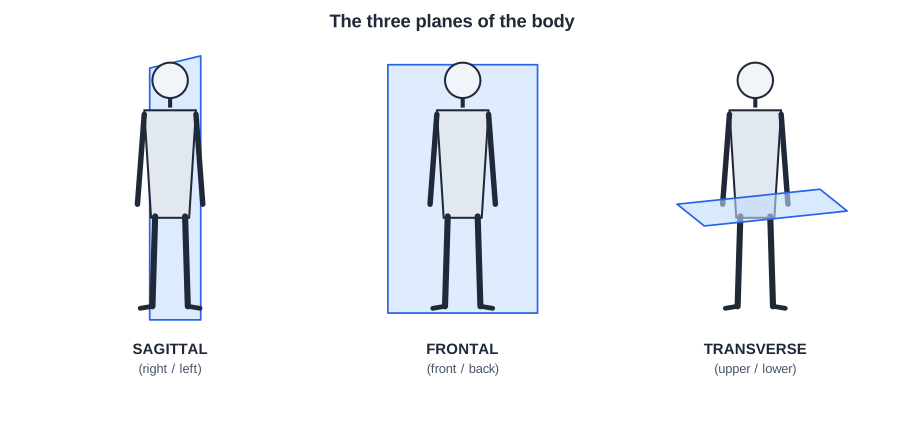
Drawn by us to help you understand the concept clearly, and verified to make sure it's accurate. For exams, practice from your textbook's own diagram.
Three standing figures, each cut by one translucent plane: SAGITTAL (a vertical plane running front-to-back, dividing the body into right and left halves), FRONTAL (a vertical plane running side-to-side, dividing the body into front and back halves), and TRANSVERSE (a horizontal pla …
The three planes
- a. Sagittal plane (median plane) — lies vertically and divides the body into right and left parts. Flexion and extension occur in this plane. Examples: kicking a football, a chest pass in netball, walking, jumping and squatting.
- b. Frontal plane (lateral or coronal plane) — also lies vertically and divides the body into anterior (front) and posterior (back) parts. Abduction and adduction occur in this plane. Examples: jumping-jack exercises, raising and lowering the arms and legs sideways, and a cartwheel.
- c. Transverse plane (horizontal plane) — lies horizontally and divides the body into superior (upper) and inferior (lower) parts. Rotation occurs in this plane. Examples: hip rotation in a golf swing, twisting in a discus throw, pivoting in netball and spinning in skating.
The median plane versus parallel sagittal planes
Strictly, only the plane running exactly through the body's midline — dividing it into equal left and right halves — is called the median (mid-sagittal) plane. Any plane running parallel to it but offset to one side (for example, one passing only through the left shoulder and left hip) is simply called a sagittal plane. Both are still "sagittal" in the sense that flexion and extension happen within them; the median plane is just the special case that splits the body exactly in half.
Telling the three planes apart quickly
A common exam mistake is confusing the frontal and transverse planes. The quickest check is to ask which two body parts the plane separates: the sagittal plane separates left from right, the frontal plane separates front from back, and the transverse plane separates top from bottom. Once you know which two parts are being separated, the plane — and therefore the type of movement possible within it — follows immediately.