Business Studies · Ch 5 — Organising
Delegation
Delegation
Delegation is the tool a manager uses to get work done through others. A manager, no matter how capable, cannot do every task alone — the sheer volume of work makes it impractical. So if a manager wishes to meet organisational goals and ensure all work is accomplished, he must delegate authority. Delegation refers to the downward transfer of authority from a superior to a subordinate.
Why delegation is necessary
The first and most obvious reason is workload reduction. By assigning routine jobs to subordinates, the manager frees up time to concentrate on high-priority activities. This is why the chapter calls delegation a pre-requisite to the efficient functioning of an organisation. It also satisfies the subordinate's need for recognition and gives them the opportunity to develop and exercise initiative.
Delegation also helps a manager extend his area of operations. Without it, a manager's activities would be restricted to only what he himself can do. By delegating, he multiplies his reach through the efforts of his subordinates.
Benefits for the subordinate
Delegation is not one-sided. When a subordinate is given responsibility and the authority to match it, they are forced to think, decide and act. This develops their ability to deal effectively with challenges and helps them realise their full potential. Over time, this builds a pipeline of capable employees who are ready to take on greater responsibilities.
Delegation is not abdication …
Delegation is the process a manager follows in dividing the work assigned to him so that he performs that part which only he, because of his unique organisational placement, can perform effectively and so that he can get others to help with what remains.
— Louis Allen …
Drawn by us to help you understand the concept clearly, and verified to make sure it's accurate. For exams, practice from your textbook's own diagram.
What the Illustration Shows
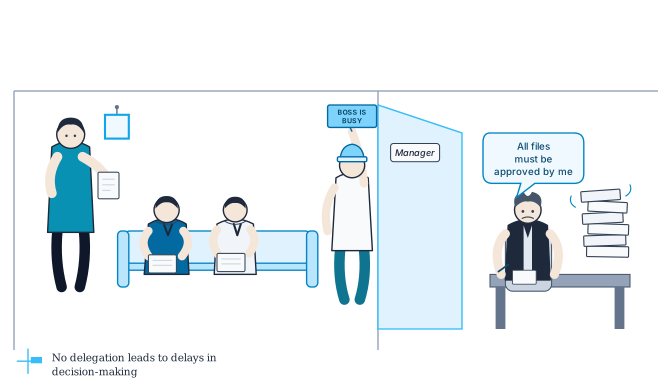
Our own simplified scene splits into two halves by an open office door marked Manager. Outside, three people wait — a colleague holding papers, and two more seated on a couch working through documents on their laps — while an office peon stands right at the threshold holding up a sign: "BOSS IS BUSY." Inside, the manager himself sits hunched over his desk beside a tall, teetering stack of files, insisting: "All files must be approved by me."
What It Teaches …
Drawn by us to help you understand the concept clearly, and verified to make sure it's accurate. For exams, practice from your textbook's own diagram.
What the Illustration Shows
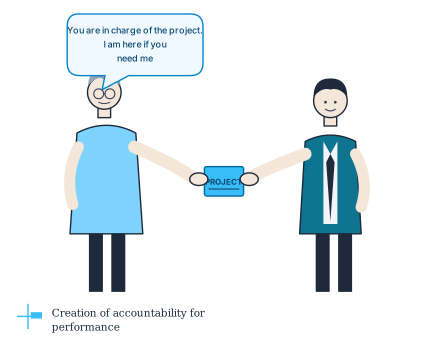
A superior hands a subordinate a folder labelled PROJECT, telling him: "You are in charge of the project. I am here if you need me."
What It Teaches
Handing over the file is only the visible half of the exchange. Along with the work, the superior is also handing the subordinate responsibility — the obligation to properly perform the assigned duty — and, by saying he remains available, signalling that he as the superior stays accountable for the outcome, because accountability can never itself be delegated away. This is the third element of delegation: once authority is delegated and responsibility accepted, the subordinate mus …
| Basis | Authority | Responsibility | Accountability |
|---|---|---|---|
| Meaning | Right to command. | Obligation to perform an assigned task. | Answerability for outcome of the assigned task. |
| Delegation | Can be delegated. | Cannot be entirely delegated. | Cannot be delegated at all. |
| Origin | Arises from formal position. | Arises from delegated authority. | Arises from responsibility. |