Economics · Ch 6 — Open Economy Macroeconomics
Capital Account
Capital Account
Capital Account
The capital account records all international transactions that involve assets. An asset is any form in which wealth can be held — money, stocks, bonds, government debt, real estate, or a company. When a resident of one country buys an asset abroad, foreign exchange flows out of the country; when a foreigner buys a domestic asset, foreign exchange flows in.
Debit and Credit Items
-
Debit item (outflow of foreign exchange): Purchase of an asset from abroad.
Example: An Indian buys a UK car company. This is a debit on India’s capital account because Indian rupees are exchanged for pounds to pay for the asset, and foreign exchange leaves India.
-
Credit item (inflow of foreign exchange): Sale of an asset to a foreigner.
Example: A Chinese customer buys shares of an Indian company. This is a credit on India’s capital account because the Chinese buyer pays in foreign currency (say, dollars or yuan), which enters India.
Do not confuse the capital account with the current account. The current account records trade in goods, services, and unilateral transfers. The capital account records trade in assets — financial instruments, property, and loans.
Components of the Capital Account
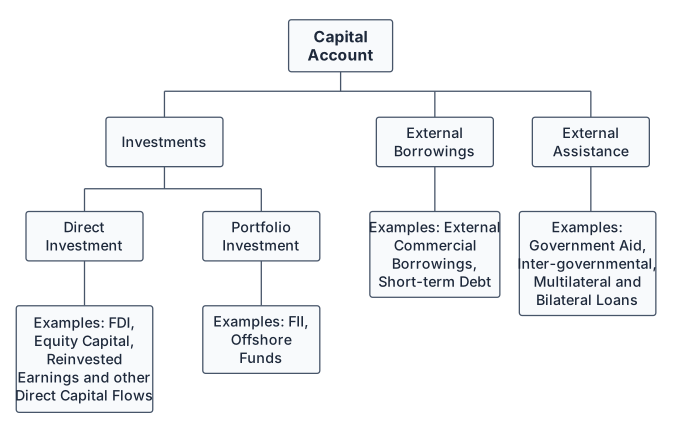
The textbook lists three main categories of capital account transactions, shown in Figure 6.2:
-
Foreign Direct Investments (FDIs) — long-term investments where the investor acquires a lasting interest in a foreign enterprise (e.g., building a factory, buying a controlling stake in a company). FDI typically involves management control.
-
Foreign Institutional Investments (FIIs) — investments by foreign institutions (mutual funds, pension funds, hedge funds) in a country’s financial markets — stocks, bonds, and other securities. These are usually shorter-term and more liquid than FDI.
-
External borrowings and assistance — loans taken by the government or private sector from foreign lenders (other governments, international organisations like the World Bank, or commercial banks), and grants or aid received from abroad.
Drawn by us to help you understand the concept clearly, and verified to make sure it's accurate. For exams, practice from your textbook's own diagram.
The capital account records transactions in assets, grouped in the chart into investments, external borrowings and external assistance. Investments split into direct investment (for example FDI, equity capital and reinvested earnings) and portfolio investment (for example FII and offshore funds); external borrowings cover external commercial borrowings and short-term debt, while external assistance covers …
The textbook’s Figure 6.2 is a classification chart, not a graph — it carries no numerical values. Beyond the three broad heads the prose names, the chart itself also splits investments into direct investment (for example FDI, equity capital and reinvested earnings) and portfolio investment (for example FII and offshore funds), and attaches examples to external borrowings (external commercial borrowings, short-term debt) and external assistance (government aid; inter-governmental, multilateral and bilateral loans).
Balance on Capital Account
The capital account is said to be in balance when capital inflows equal capital outflows.
- Capital inflows (credit items): Receipt of loans from abroad, sale of assets or shares to foreign residents, foreign direct investment coming into the country.
- Capital outflows (debit items): Repayment of loans to foreign lenders, purchase of assets or shares abroad, outward FDI. …