Physical Education · Ch 10 — Training in Sports
Coordinative Abilities
Coordinative Abilities
Coordinative Abilities — Meaning
Coordinative abilities depend primarily on the central nervous system's motor control and regulation processes. For a coordinative ability to work, these control-and-regulation processes must function in a particular, well-organised manner. In simple terms, coordinative abilities are the abilities that enable a person to perform various activities correctly and efficiently.
As Zimmerman and colleagues (cited in the textbook) put it, coordinative abilities are relatively stabilised and generalised patterns of motor control and regulation that enable the sportsperson to perform a group of movements with better quality and effect. Because they are governed by the nervous system, they are the foundation on which sport-specific skills are built — a player with strong coordinative abilities learns new skills faster and performs them with less wasted effort. This is a frequently examined topic in CBSE Class 12 Physical Education question papers.
Coordinative abilities are best trained when the athlete is fresh, early in a session after the warm-up. Fatigue impairs the nervous system, so training them when tired reinforces poor movement patterns.
Types of Coordinative Ability
The NCERT/CBSE textbook identifies seven coordinative abilities essential in sport; the demand on each differs from game to game.
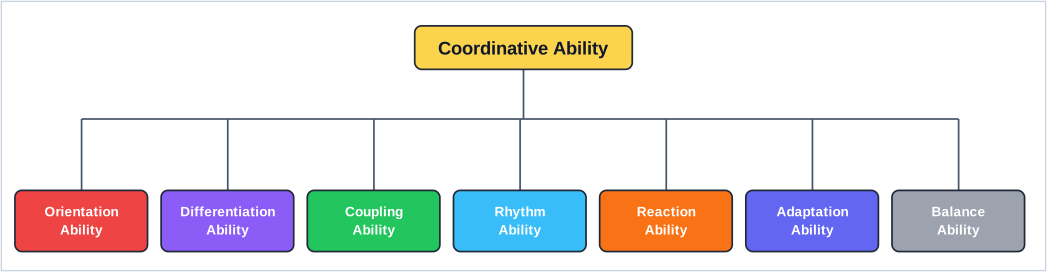
Drawn by us to help you understand the concept clearly, and verified to make sure it's accurate. For exams, practice from your textbook's own diagram.
A classification tree. The top box 'Coordinative Ability' branches to seven boxes on one level: 'Orientation Ability', 'Differentiation Ability', 'Coupling Ability', 'Rhythm Ability', 'Reaction Ability', 'Adaptation Ability' and 'Balance Ability'. (The 2022 printed chart labels the sixth box 'Application ability'; this redraw uses 'Adaptation Ability' to match …
- Orientation Ability — the ability to determine and change the position and movement of the body in the required time and the available space, with respect to a definite field of action (a volleyball court, skating rink, football ground) and a moving object (a ball, opponent or partner). Example: in gymnastics, body position in the air depends on orientation; in team games, peripheral vision is decisive for it.
- Differentiation Ability — the ability to attain a high fine-tuning of the movement phases, i.e. a high level of accuracy. It depends on movement experience and mastery over motor actions, and shows up as a well-developed movement sense. Example: judging exactly how much force to put into a delicate badminton net shot.
- Coupling Ability — the ability to coordinate the movements of different body parts with one another and towards a definite, goal-oriented body movement. It is essential in difficult activities such as gymnastics and team games. Example: in football, foot movements for ball control or dribbling must be coupled with the whole-body action of running and jumping. It depends on the kinaesthetic and visual sense organs.
- Rhythm Ability — the ability to perceive the rhythm of a movement and perform the movement with the required rhythm, and to reproduce a rhythm stored in motor memory. Example: in gymnastics or figure skating the performer perceives an external rhythm (music) and expresses it in movement; where no external rhythm is given, the sportsperson uses the rhythm stored in memory.
- Reaction Ability — the ability to react quickly and effectively to a stimulus, which may be visual, auditory or tactile. It is further classified into simple reaction (one response to one signal) and complex reaction (choosing the right response among several). Example: a sprinter reacting to the starter's gun; a goalkeeper reading a penalty kick. …