Botany · Ch 1 — Biological Classification
Viruses, Viroids, Prions and Lichens
Viruses, Viroids, Prions and Lichens
In the five kingdom classification of Whittaker there is no mention of lichens and some acellular organisms like viruses, viroids and prions. These are briefly introduced here.
Viruses did not find a place in classification since they are not considered truly 'living', if we understand living as those organisms that have a cell structure. Viruses are non-cellular organisms characterised by an inert crystalline structure outside the living cell. Once they infect a cell, they take over the machinery of the host cell to replicate themselves, killing the host.
The word virus means venom or poisonous fluid. Dmitri Ivanowsky (1892) recognised certain microbes as the causal organism of the mosaic disease of tobacco; these were smaller than bacteria because they passed through bacteria-proof filters. M.W. Beijerinck (1898) demonstrated that the extract of infected tobacco plants could cause infection in healthy plants, and named the fluid Contagium vivum fluidum (infectious living fluid). W.M. Stanley (1935) showed that viruses could be crystallised and that crystals consist largely of proteins. Viruses are inert outside their specific host cell and are obligate parasites.
Structure and genetic material of viruses:
- in addition to proteins, viruses contain genetic material that could be either RNA or DNA — no virus contains both RNA and DNA
- a virus is a nucleoprotein, and its genetic material is infectious
- viruses that infect plants have single stranded RNA; viruses that infect animals have single or double stranded RNA or double stranded DNA
- bacteriophages (bacterial viruses) are usually double stranded DNA viruses
- the protein coat called the capsid, made of small subunits called capsomeres, protects the nucleic acid; the capsomeres are arranged in helical or polyhedral geometric forms
Viruses cause diseases like mumps, small pox, herpes and influenza; AIDS in humans is also caused by a virus. In plants, symptoms can be mosaic formation, leaf rolling and curling, yellowing and vein clearing, dwarfing and stunted growth.
Viroids: In 1971, T.O. Diener discovered a new infectious agent that was smaller than viruses and caused potato spindle tuber disease. It was found to be a free RNA; it lacked the protein coat found in viruses, hence the name viroid. The RNA of the viroid was of low molecular weight.
Prions: In modern medicine, certain infectious neurological diseases were found to be transmitted by an agent consisting of abnormally folded protein. The agent was similar in size to viruses, and these agents were called prions. The most notable diseases caused by prions are bovine spongiform encephalopathy (BSE) — commonly called mad cow disease in cattle — and its analogous variant Creutzfeldt-Jacob disease (CJD) in humans. …
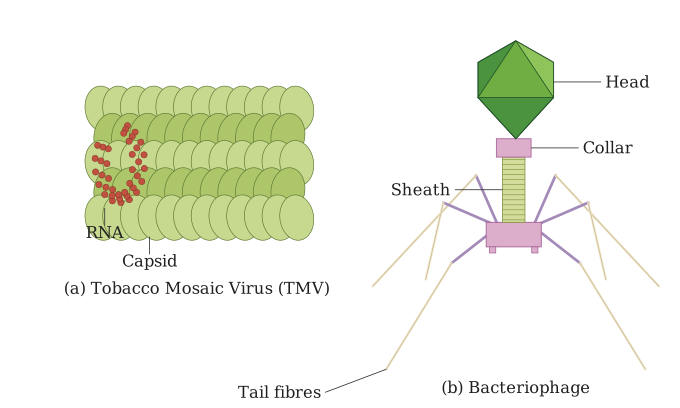
Drawn by us to help you understand the concept clearly, and verified to make sure it's accurate. For exams, practice from your textbook's own diagram.
This figure compares two viruses. In (a) the Tobacco Mosaic Virus (TMV) is drawn as a rod-shaped particle; its central thread of RNA, the infectious genetic material, is coiled within a protective protein coat labelled the capsid, made of many small subunits arranged in a helical form. In (b) a bacteriophage — a virus that infects bacteria and is usually a double stranded DNA virus — is shown with a clearly regional body: a polyhedral head that encloses the genetic material, a short collar, a tubular sheath, and tail fibres at the base that anchor the phage to the b …