Botany · Ch 6 — Biomolecules
Factors Affecting Enzyme Activity
Factors Affecting Enzyme Activity
How fast an enzyme works is not fixed; it responds to the conditions around it. Anything that disturbs the delicate three-dimensional (tertiary) folding of the enzyme's protein will change how well it functions. The main influences are temperature, pH, the amount of substrate available, and the presence of particular chemicals that bind to the enzyme and regulate it.
Temperature and pH
Most enzymes operate well only within a narrow band of temperature and of pH. For each enzyme there is one temperature and one pH at which it is most active; these are called its optimum temperature and optimum pH. On either side of that best value, the activity falls away.
- Low temperature does not usually harm the enzyme. It merely slows it into a temporarily inactive state, and the enzyme can recover its activity when warmed again.
- High temperature is destructive. Excess heat denatures the protein, unravelling its folded structure, so the enzymatic activity is lost and does not return.
Concentration of substrate
When more substrate is supplied, the speed of the enzyme-catalysed reaction climbs at first. However, it does not rise without limit: it levels off at a ceiling called the maximum velocity, or Vmax, which no further addition of substrate can push past. The reason is one of numbers. The enzyme molecules are far fewer than the substrate molecules, so once every enzyme molecule is occupied, the enzymes are said to be saturated. There are then no free enzyme molecules left to take on the extra substrate, and the rate cannot increase any more.
Inhibitors and competitive inhibition
Enzyme activity is also sensitive to specific chemicals that attach to the enzyme. When such a chemical binds and shuts down the enzyme's activity, the effect is called inhibition and the chemical itself is an inhibitor. …
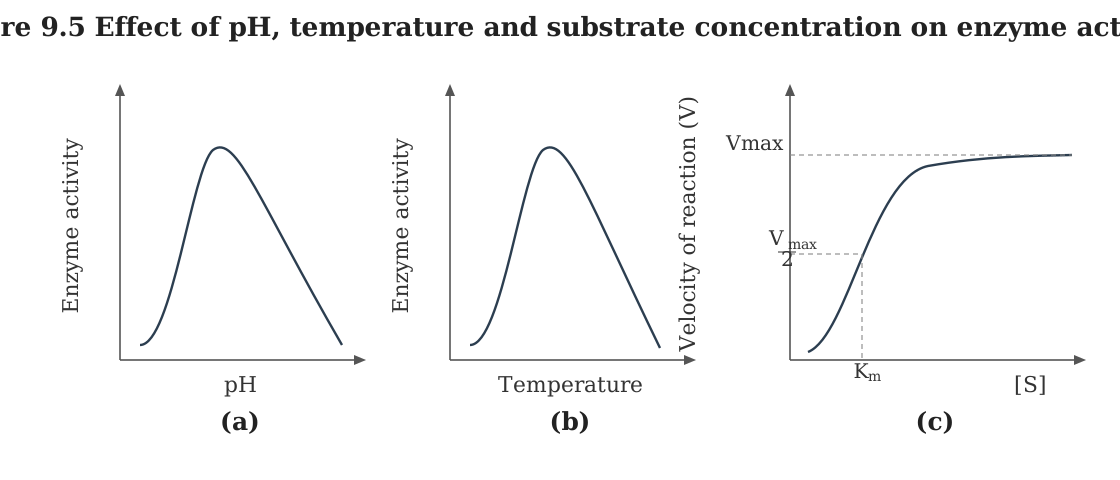
Drawn by us to help you understand the concept clearly, and verified to make sure it's accurate. For exams, practice from your textbook's own diagram.
These three graphs show how the rate (velocity) of an enzyme-catalysed reaction responds to three conditions. (a) With pH, the activity is highest at a particular optimum pH and falls off on either side, because an extreme pH alters the enzyme's shape.
(b) With temperature, the activity rises to an optimum temperature and then drops sharply, because too much heat denatures (unfolds) the enzyme and destroys its active site. …