Botany · Ch 8 — Photosynthesis in Higher Plants
Early Experiments
Early Experiments
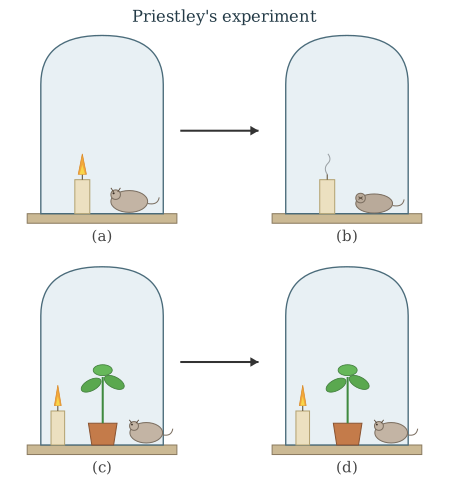
It is fascinating to trace the simple experiments that led, step by step, to our present understanding of photosynthesis. Joseph Priestley (1733-1804), in 1770, performed a famous series of experiments that revealed the essential role of air in the growth of green plants. Priestley, you may recall, discovered oxygen in 1774. He observed that a candle burning inside a closed space, such as a bell jar, soon gets extinguished, and that a mouse placed in a closed space would soon suffocate. From this he concluded that a burning candle or a breathing animal somehow damages the air. But when he placed a mint plant in the same bell jar, he found that the mouse stayed alive and the candle continued to burn. Priestley therefore hypothesised that plants restore to the air whatever breathing animals and burning candles remove.
- A burning candle or a breathing animal fouls the air of a closed space.
- A green plant kept in the same space purifies or restores that air.
Jan Ingenhousz (1730-1799) took Priestley's setup further. By placing it once in the dark and once in the sunlight, he showed that sunlight is essential for the plant process that purifies the air fouled by candles or animals. In an elegant experiment with an aquatic plant, he observed that small bubbles formed around the green parts in bright sunlight but not in the dark. He later identified these bubbles as oxygen, thereby showing that it is only the green part of the plant that could release oxygen.
It was not until about 1854 that Julius von Sachs provided evidence for the production of glucose when plants grow. He showed that glucose is usually stored as starch, and that the green substance in plants (chlorophyll, as we call it now) is located in special bodies (later called chloroplasts) within the cells; the green parts are where glucose is made.
T.W. Engelmann (1843-1909) used a prism to split light into its spectral components and illuminated a green alga, Cladophora, placed in a suspension of aerobic bacteria. The bacteria, which gathered where oxygen was released, accumulated mainly in the blue and red regions of the split spectrum. This described the first action spectrum of photosynthesis, which roughly resembles the absorption spectra of chlorophyll a and b.
By the middle of the nineteenth century, the key features were known: plants could use light energy to make carbohydrates from CO2 and water. The empirical equation for oxygen-evolving organisms was:
CO₂ + H₂O → (Light) [CH₂O] + O₂
where [CH2O] represents a carbohydrate (e.g., glucose, a six-carbon sugar).
A major contribution came from Cornelius van Niel (1897-1985), who, from his studies of purple and green bacteria, demonstrated that photosynthesis is essentially a light-dependent reaction in which hydrogen from a suitable oxidisable compound reduces carbon dioxide to carbohydrates. This can be expressed by:
2H₂A + CO₂ → (Light) 2A + CH₂O + H₂O …
Drawn by us to help you understand the concept clearly, and verified to make sure it's accurate. For exams, practice from your textbook's own diagram.
This figure illustrates Joseph Priestley's classic bell-jar experiments in four parts. In (a) and (b) a burning candle and a mouse are placed in a closed bell jar; the candle soon goes out and the mouse suffocates, showing that both damage or foul the air. In (c) and (d) a green mint plant is enclosed together with a candle and a mouse in the bell jar; now the mouse survives and the candle keeps burning. Priestley concluded that plants restore to the air whatever breathing animals and burning candles remove. The experiment was among the fir …