Chemistry · Ch 6 — Equilibrium
Liquid-Vapour Equilibrium
Liquid-Vapour Equilibrium
Liquid-Vapour Equilibrium
The equilibrium between a liquid and its vapour is a dynamic state that we encounter in everyday life — a covered water bottle, a sealed perfume vial, or steam above hot tea. To understand what exactly happens at the molecular level, consider a simple experiment.
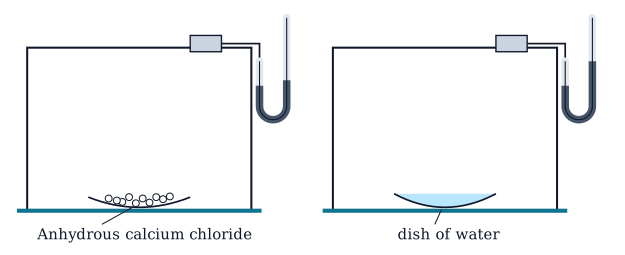
A transparent box is fitted with a U-tube manometer (mercury-filled) to measure pressure. First, a drying agent such as anhydrous calcium chloride or phosphorus pentaoxide is placed inside the box for a few hours to absorb any moisture already present. After removing the drying agent by tilting the box, a watch glass containing water is quickly placed inside, and the box is sealed.
What do you observe? The mercury level in the right limb of the manometer slowly rises — meaning the pressure inside the box is increasing. After some time, the mercury level becomes constant. Simultaneously, the volume of water in the watch glass decreases.
Initially, there was almost no water vapour inside the box. As water evaporates, water molecules enter the gaseous phase, increasing the pressure. The rate of evaporation is constant — at a given temperature, a fixed number of molecules escape the liquid surface per unit time. But as more vapour accumulates, some of these gaseous molecules collide with the liquid surface and re-enter the liquid phase. This is condensation. The rate of condensation depends on the concentration of vapour molecules — the higher the vapour pressure, the faster the condensation.
At first, evaporation dominates. But as vapour builds up, the condensation rate increases. Eventually, the two rates become equal:
At this point, there is no net change in the amount of liquid or vapour. The system has reached liquid-vapour equilibrium:
The pressure exerted by the vapour at equilibrium at a given temperature is called the equilibrium vapour pressure of the liquid, or simply its vapour pressure. This pressure remains constant as long as the temperature does not change.
Drawn by us to help you understand the concept clearly, and verified to make sure it's accurate. For exams, practice from your textbook's own diagram.
What Figure 6.1 Actually Shows
Fig. 6.1 is a two-part comparison experiment. It shows two identical sealed boxes, each connected to its own U-tube mercury manometer. The left box contains a watch glass of anhydrous calcium chloride — a drying agent that keeps the air inside completely free of water vapour. The right box contains a dish of water.
The left box is the control: with no water vapour present, the mercury stands at the same level in both arms of its manometer — there is no extra pressure to measure. In the right box, water evaporates into the enclosed air, and the growing vapour pushes the mercury up the open arm of its manometer. At first the level rises steadily, but the rise slows and finally stops changing altogether — even though liquid water is still present in the dish.
The Physical Idea
That constant final mercury difference is the whole point of the figure. When the dish is first sealed in, evaporation dominates. As vapour accumulates, more and more molecules also return to the liquid (condensation), until the two rates become equal:
From that moment the amount of vapour — and therefore the manometer reading — stays fixed, even though molecules are constantly swapping between liquid and vapour. The steady reading is the equilibrium vapour pressure of water at that temperature.
The manometer difference measures the vapour pressure directly, and the dry calcium-chloride box proves the reading comes from water vapour alone — not from the trapped air. At a given constant temperature the equilibrium vapour pressure is a fixed, reproducible number; it increases if the temperature is raised.
[!WATCH OUT] …
Vapour pressure is a property of the liquid at a specific temperature. It does not depend on the amount of liquid or the size of the container — only on the nature of the liquid and the temperature.
Vapour Pressure Increases with Temperature
If you repeat the same experiment at a higher temperature, the equilibrium vapour pressure is higher. Why? At higher temperatures, molecules in the liquid have greater kinetic energy. A larger fraction of them can overcome the intermolecular forces holding them in the liquid and escape into the vapour phase. Both the rate of evaporation and the equilibrium vapour pressure therefore increase with temperature.
Different Liquids Have Different Vapour Pressures
Repeat the experiment with methyl alcohol, acetone, and ether — all at the same temperature. You will find that each liquid reaches a different equilibrium vapour pressure. The liquid with the highest vapour pressure at a given temperature is said to be the most volatile. Volatility is a measure of how readily a liquid evaporates.
A liquid with a higher vapour pressure at a given temperature is more volatile and has a lower boiling point. This is a direct relationship: stronger intermolecular forces → lower vapour pressure → higher boiling point. Weaker forces → higher vapour pressure → lower boiling point.
Open Systems Cannot Reach Equilibrium
Now consider a different scenario. Place three watch glasses containing 1 mL each of acetone, ethyl alcohol, and water in an open room. The liquid eventually disappears completely. The time taken depends on three factors:
- The nature of the liquid — more volatile liquids evaporate faster.
- The amount of the liquid — larger volumes take longer to evaporate.
- The temperature — higher temperatures speed up evaporation.
In an open system, the vapour molecules that escape are dispersed into the large volume of the room. They do not accumulate near the liquid surface. As a result, the rate of condensation (vapour molecules returning to the liquid) is much smaller than the rate of evaporation. The system never reaches equilibrium — the liquid keeps evaporating until it is gone.
Equilibrium between a liquid and its vapour is only possible in a closed system — one where the vapour cannot escape. An open container of water will never reach equilibrium with the atmosphere; it will eventually dry out.