Chemistry · Ch 2 — Structure of Atom
Energies of Orbitals
Energies of Orbitals
Energy of Orbitals: Hydrogen vs. Multi-Electron Atoms
The energy of an electron in an orbital is not a fixed, universal number. It depends critically on whether the atom has one electron (like hydrogen) or many electrons. This distinction is the central idea of this section.
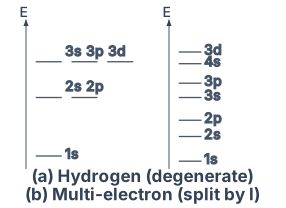
Drawn by us to help you understand the concept clearly, and verified to make sure it's accurate. For exams, practice from your textbook's own diagram.
Fig. 2.16 is a side-by-side comparison of two vertical energy-level diagrams. In each panel, energy increases upward along the vertical axis, and horizontal dashed lines mark the positions of individual orbitals. The left panel shows the hydrogen atom (levels 1s; 2s 2p; 3s 3p 3d); the right panel shows a multi-electron atom, where 4s also appears — drawn below 3d.
The hydrogen diagram is simple: all orbitals that share the same principal quantum number sit at exactly the same height. So 2s and 2p are on the same line; 3s, 3p, and 3d are on a single line above them; 4s stands alone. This is the degeneracy of hydrogen — the energy depends only on , not on the azimuthal quantum number .
The multi-electron diagram tells a different story. Here the same does not guarantee the same energy. The 2s line is lower than the 2p line; 3s is lower than 3p, which is lower than 3d. Most strikingly, the 4s orbital sits below 3d, even though is larger than . This is the “staggering” or energy-level crossing that the textbook describes: for multi-electron atoms, the order of orbital energies follows the rule, not simply the principal quantum number.
The key physical idea is that in a hydrogen atom the only interaction is the Coulomb attraction between the single electron and the nucleus. In multi-electron atoms, each electron also feels repulsion from every other electron, and inner electrons partially shield the nuclear charge. This shielding is different for s, p, d orbitals because their radial distributions differ — an s electron spends more time near the nucleus than a p electron of the same shell, so it is less shielded and more tightly bound. Hence the energy ordering for a given , and the possibility of .
The textbook uses this figure to introduce the rule, which predicts the order of orbital energies in multi-electron atoms:
For example, 4s has , while 3d has . Since , 4s lies below 3d — exactly what the diagram shows. Similarly, 3p () lies above 3s () because the values differ, and 3p () lies below 4s () even though both have , because the rule says the orbital with smaller wins.
Do not confuse the hydrogen diagram with the multi-electron diagram. In hydrogen, 3d and 3s have the same energy; in multi-electron atoms, 3d is higher than 3s. Many exam questions test whether you know that the rule applies only to multi-electron atoms, not to hydrogen. …
Energy in the Hydrogen Atom: Dependence Only on
In a hydrogen atom (or any one-electron system), the only electrical interaction is the electrostatic attraction between the single electron and the nucleus. There are no other electrons to cause repulsion. As a result, the energy of an orbital is determined solely by the principal quantum number .
The energy of orbitals in hydrogen increases in the following order:
This means that for a given value of , all subshells (, , , ) have exactly the same energy. For example, the and orbitals have different shapes, but an electron in either one possesses the same energy. Orbitals that share the same energy are called degenerate orbitals.
The orbital corresponds to the most stable condition, called the ground state. An electron in this orbital is most strongly held by the nucleus. An electron in any , , or higher orbital is in an excited state.
In a hydrogen atom, energy depends only on . All subshells within the same shell are degenerate.
Energy in Multi-Electron Atoms: Dependence on Both and
The situation changes dramatically when an atom has more than one electron. In a multi-electron atom, the energy of an electron depends on both its principal quantum number () and its azimuthal quantum number (). This means that for a given , the , , , and subshells all have different energies.
Within a given principal quantum number, the energy of orbitals increases in the order:
For higher energy levels, these differences become so pronounced that the energy ordering can "stagger" — meaning an orbital from a higher shell can have lower energy than an orbital from a lower shell. Examples include:
Do not assume that the order of filling orbitals follows the order of alone. The staggering of energies (e.g., being lower than ) is a key feature of multi-electron atoms.
Why Do Subshells Have Different Energies in Multi-Electron Atoms?
The root cause is electron-electron repulsion. In a hydrogen atom, the only force is attraction between the electron and the nucleus. In a multi-electron atom, there are two types of interactions:
- Attraction between each electron and the nucleus.
- Repulsion between each electron and every other electron.
The overall stability of an electron comes from the fact that the total attractive interactions outweigh the repulsive ones. However, the repulsive interactions — especially those between outer-shell electrons and inner-shell electrons — are very important.
Shielding and Effective Nuclear Charge ()
Because of the inner-shell electrons, an electron in an outer shell does not experience the full positive charge of the nucleus (). The inner electrons partially "screen" or "shield" the outer electron from the nucleus. The net positive charge that an outer electron actually feels is called the effective nuclear charge ().
Despite this shielding, the attractive force experienced by an outer electron increases as the nuclear charge increases. In other words, the orbital energy (the energy of interaction between the nucleus and the electron) becomes more negative (lower) as the atomic number increases.
The Role of Orbital Shape
Both the attractive and repulsive interactions depend on the shell () and the shape () of the orbital. The key difference lies in how effectively electrons in different subshells shield outer electrons, and how close an electron in a given subshell can get to the nucleus.
- An electron in a spherical orbital spends more time close to the nucleus compared to an electron in a orbital of the same shell.
- An electron in a orbital spends more time near the nucleus than an electron in a orbital of the same shell.
This has two consequences:
- Shielding: Electrons in orbitals shield outer electrons from the nucleus more effectively than orbital electrons, which in turn shield more effectively than orbital electrons.
- Binding: Because an electron spends more time near the nucleus, it experiences a greater effective nuclear charge () than a electron in the same shell. The electron experiences a greater than a electron.
For a given shell, decreases as increases: .
Since a higher means a stronger attraction and a lower (more negative) energy, the energy of electrons in a given shell follows the same order:
This is the reason for the splitting of energy levels within the same shell in multi-electron atoms.
The Rule: A Simple Guide to Orbital Energies
The exact mathematical dependence of orbital energy on and is complicated, but a simple rule — the rule — helps predict the relative energies of orbitals.
The Rule
Table 2.5 (the book's own table) illustrates this rule up to 4p.
| Orbital | Value of | Value of | Value of | Comparison |
|---|---|---|---|---|
| 1s | 1 | 0 | ||
| 2s | 2 | 0 | ||
| 2p | 2 | 1 | has lower energy than | |
| 3s | 3 | 0 | ||
| 3p | 3 | 1 | has lower energy than | |
| 4s | 4 | 0 |
Continuing the same rule beyond the book's table: → → — which completes the familiar filling order used in Section 2.6.4.
Applying the rule:
- vs : has . has . Since , has lower energy than .
- vs : has . has . They have the same value. The rule says the orbital with the lower has the lower energy. Since for and for , has lower energy than . …