Chemistry · Ch 5 — Thermodynamics
Measurement of ΔU and ΔH: Calorimetry
Measurement of ΔU and ΔH: Calorimetry
Both and are measured experimentally using calorimetry — tracking the temperature change of a known quantity of surrounding fluid (usually water) to work out how much heat a process released or absorbed:
- ΔU Measurements — the bomb calorimeter, run at constant volume. …
ΔH Measurements
ΔH Measurements
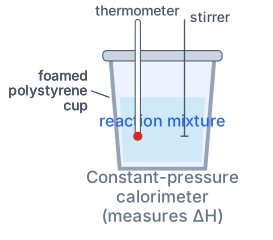
Measurement of heat change at constant pressure () is done in a simpler calorimeter, often a Styrofoam cup or a beaker, open to the atmosphere (Fig. 5.8). This ensures the pressure remains constant at 1 atm.
We know from the definition of enthalpy that at constant pressure:
The heat absorbed or evolved at constant pressure, , is also called the heat of reaction or the enthalpy of reaction, denoted as .
Sign Convention for :
- Exothermic reaction: Heat is evolved (system loses heat to surroundings). Therefore, is negative, and is negative.
- Endothermic reaction: Heat is absorbed (system gains heat from surroundings). Therefore, is positive, and is positive.
The fundamental distinction is clear:
- Bomb calorimeter (constant volume) measures .
- Constant-pressure calorimeter measures . …
Drawn by us to help you understand the concept clearly, and verified to make sure it's accurate. For exams, practice from your textbook's own diagram.
The figure shows a simple calorimeter built from a foamed-polystyrene cup, a lid, a thermometer, and a stirrer. The cup sits open to the atmosphere, so the entire experiment proceeds at constant pressure — the pressure of the room. Inside the cup is the reaction mixture, and the thermometer dips into it to record the temperature change as the reaction proceeds. The stirrer ensures the temperature is uniform throughout the mixture.
The physical idea is straightforward: if a reaction happens at constant pressure, the heat exchanged with the surroundings equals the change in enthalpy, . By measuring the temperature rise (or fall) of the known mass of the reaction mixture, you can calculate the heat absorbed or released. The calorimeter itself is well insulated by the foam, so very little heat escapes to the surroundings — nearly all the heat from the reaction stays inside the cup and warms (or cools) the mixture.
The key formula that emerges from this figure is the one used to compute from the measured temperature change:
Here is the heat exchanged at constant pressure (which equals for the reaction), is the mass of the reaction mixture (in grams), is its specific heat capacity (in ), and is the change in temperature (in K or °C — the numerical value is the same for a difference). For dilute aqueous solutions, is taken as , the specific heat capacity of water.
The sign of matters. If the temperature rises (), the reaction is exothermic and is negative (heat leaves the system). If the temperature falls (), the reaction is endothermic and is positive. The formula gives the magnitude; you must assign the sign based on the direction of heat flow.
The textbook then uses this measured to find the enthalpy change per mole of reactant. If moles of the limiting reactant are consumed, the molar enthalpy change is:
…