Mathematics · Ch 11 — Introduction to Three-Dimensional Geometry
Coordinates of a Point in Space
Coordinates of a Point in Space
Coordinates of a Point in Space
Once we have fixed a coordinate system — the three mutually perpendicular axes (x, y, z), the three coordinate planes (XY, YZ, ZX), and the origin O — the next task is to connect every point in space with an ordered triplet of real numbers, and vice versa. This is the fundamental bridge between geometry and algebra in three dimensions.
The Perpendicular Projection Method
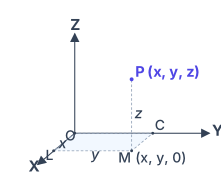
Take any point P in space. Drop a perpendicular from P onto the XY-plane. Let M be the foot of this perpendicular — that is, the point on the XY-plane directly below (or above) P. Now, from M, draw a perpendicular to the x-axis, meeting it at L.
Three distances now define the position of P:
- — the distance along the x-axis from the origin to L
- — the distance from L to M, measured parallel to the y-axis
- — the vertical distance from M up to P, measured parallel to the z-axis
These three numbers , , and are called the x-coordinate, y-coordinate, and z-coordinate of the point P, respectively. We write the point as .
In the figure typically used (Fig 11.2 of the textbook), the point P lies in the octant XOYZ, where all three coordinates are positive. If P were in a different octant, the signs of , , and would change accordingly.
Thus, to each point P in space there corresponds exactly one ordered triplet of real numbers.
The Reverse Process: From Triplet to Point
Conversely, given any ordered triplet , we can locate the corresponding point in space:
- First, fix point L on the x-axis at distance from the origin.
- From L, move in the XY-plane to locate point M such that are the coordinates of M in the XY-plane. Here, LM is perpendicular to the x-axis (or equivalently, parallel to the y-axis).
- At M, draw a perpendicular to the XY-plane. Along this perpendicular, measure a distance to reach point P.
The point P obtained this way has coordinates .
This establishes a one-to-one correspondence between points in space and ordered triplets of real numbers. No two distinct points share the same triplet, and every triplet corresponds to exactly one point.
The Parallel Planes Method (Alternative Construction)
There is a second, equally important way to think about coordinates in space.
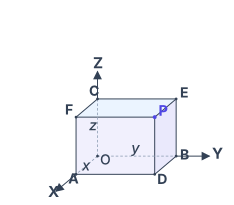
Through point P, draw three planes, each parallel to one of the coordinate planes:
- A plane parallel to the YZ-plane, meeting the x-axis at A
- A plane parallel to the ZX-plane, meeting the y-axis at B
- A plane parallel to the XY-plane, meeting the z-axis at C
Let , , and . Then the point P has coordinates .
Conversely, given , , and , locate points A, B, and C on the three axes. Through A, draw a plane parallel to the YZ-plane. Through B, draw a plane parallel to the ZX-plane. Through C, draw a plane parallel to the XY-plane. These three planes intersect at exactly one point — that point is P.
This method is often easier to visualize: the three planes act like walls that box in the point. Their intersection is unique because no two of these planes are parallel to each other.
Geometric Interpretation of Coordinates
If is any point in space, then:
- is the perpendicular distance from P to the YZ-plane
- is the perpendicular distance from P to the ZX-plane
- is the perpendicular distance from P to the XY-plane
This is a crucial insight: each coordinate measures how far the point is from one of the coordinate planes, not from the axes directly.
A common mistake is to think measures distance from the yz-plane along the x-axis. That is true only if you drop perpendiculars correctly. The coordinate is the signed distance from the YZ-plane, measured parallel to the x-axis.
Coordinates of Special Points
- The origin O has coordinates .
- Any point on the x-axis has coordinates of the form — its y and z coordinates are both zero.
- Any point on the y-axis has coordinates .
- Any point on the z-axis has coordinates .
- Any point in the YZ-plane has coordinates — its x-coordinate is zero.
- Any point in the ZX-plane has coordinates . …
Drawn by us to help you understand the concept clearly, and verified to make sure it's accurate. For exams, practice from your textbook's own diagram.
Fig 11.2 is the foundational picture for how a point gets its three coordinates. It shows a single point floating in the first octant (where all coordinates are positive), and the figure traces the path you would take to measure its , , and values.
The three axes are drawn from the origin : the -axis points straight up, the -axis points to the right, and the -axis points down and to the left (so that the three axes are not all in the same plane). The point sits in the upper-right region of the diagram. Directly below it, on the horizontal -plane, is the foot . The vertical segment is drawn dashed and labelled — it is the perpendicular from down to the -plane.
On the -plane itself, the figure shows a dashed rectangle (actually a parallelogram in perspective) with vertices , , , and . lies on the -axis, and lies on the -axis. The segment is labelled , and the segment (which runs parallel to the -axis) is labelled . So the path from to is broken into three perpendicular steps: go units along the -axis to , then units parallel to the -axis to , then units straight up to .
The physical idea is simple but crucial: the three coordinates of a point are just three perpendicular distances measured from the coordinate planes. The -coordinate is the perpendicular distance from the -plane, the -coordinate is the distance from the -plane, and the -coordinate is the distance from the -plane. The figure makes this concrete by showing the perpendicular drops one at a time.
Here is the distance from the origin to the point on the -axis, is the distance from to measured parallel to the -axis, and is the vertical distance from up to . These three numbers, taken in order, uniquely identify the point in space.
The textbook uses this figure to establish the one-to-one correspondence between points in space and ordered triples . Given any point , you can find its coordinates by dropping perpendiculars as shown. Conversely, given any triple , you can locate by first fixing on the -axis at distance , then moving parallel to the -axis to reach in the -plane, then rising vertically by . …
Drawn by us to help you understand the concept clearly, and verified to make sure it's accurate. For exams, practice from your textbook's own diagram.
What Fig. 11.3 Shows
The figure presents an alternative way to visualise the coordinates of a point in space — one that avoids dropping perpendiculars onto planes. Instead, it builds a rectangular box (a rectangular parallelepiped) whose three edges lie along the coordinate axes, meeting at the origin O.
Three points are marked on the axes: A on the x‑axis, B on the y‑axis, and C on the z‑axis. The distances from the origin to these points are labelled , , and respectively — so , , . The three edges from O to A, O to B, and O to C are drawn as dashed lines, indicating they are the hidden back edges of the box.
From A, B, and C, planes are drawn parallel to the coordinate planes: through A a plane parallel to the YZ‑plane, through B a plane parallel to the ZX‑plane, and through C a plane parallel to the XY‑plane. These three planes intersect at the point P, which is the far corner of the box opposite O. P is highlighted in indigo. The remaining three corners of the box — D, E, and F — are shown as solid points. The top face and two side faces of the box are shaded light blue to give a sense of depth.
The Physical Idea
The core insight is that the coordinates of a point P are simply the distances from the origin to the points where the three coordinate planes, shifted to pass through P, meet the axes. Instead of measuring perpendicular distances to planes directly, you can think of constructing a box whose three dimensions are exactly , , and .
This is the "alternatively" method described in the textbook: given a point P, draw three planes through P that are parallel to the coordinate planes. Where these planes cut the axes gives you the three numbers , , . Conversely, given the numbers , , , you locate A, B, C on the axes, draw the three planes through them parallel to the coordinate planes, and their intersection is P.
The coordinates , , are also the perpendicular distances from P to the YZ‑plane, ZX‑plane, and XY‑plane respectively. The box construction makes this geometric fact visually obvious: the distance from P to the YZ‑plane is exactly the length of the edge parallel to the x‑axis, which is .
Key Formula Developed with This Figure
The figure directly leads to the coordinate representation of any point in space:
Here:
- is the origin
- is the point on the x‑axis such that
- is the point on the y‑axis such that
- is the point on the z‑axis such that
- is the corner of the rectangular box opposite , obtained by drawing planes through , , parallel to the coordinate planes …