Physics · Ch 12 — Kinetic Theory
Mean Free Path
Mean Free Path
The Concept of Mean Free Path
In a gas, molecules are in constant, random motion, colliding with one another. Between two successive collisions, a molecule travels freely in a straight line. The distance it covers during this free journey is not constant — it varies randomly from one free path to the next. The mean free path is the average distance a molecule travels between two successive collisions.
The mean free path is a statistical average over a large number of molecules and over many collisions for a single molecule. It is not the distance a molecule travels in a fixed time — that would be its average speed multiplied by time.
Dependence on Molecular Size and Number Density
The mean free path depends on two factors:
- The size of the molecules — larger molecules collide more frequently, so the mean free path is shorter.
- The number density of molecules — more molecules per unit volume means more frequent collisions, again shortening the mean free path.
Let us derive an expression for the mean free path. Consider a gas of identical molecules, each treated as a hard sphere of diameter . Focus on a single molecule that is moving with an average speed . All other molecules are assumed to be stationary for the moment — we will correct this assumption later.
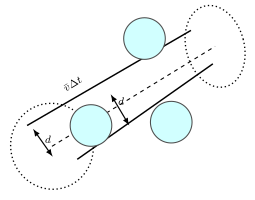
The moving molecule sweeps out a cylindrical volume as it travels. In time , it covers a distance . Any other molecule whose centre lies within a cylinder of radius (the collision diameter) around the path of the moving molecule will be hit. The cross-sectional area of this cylinder is , called the collision cross-section.
The volume swept out in time is . If is the number density (number of molecules per unit volume), then the number of collisions in time is:
The average time between collisions, , is the time in which exactly one collision occurs. Setting the number of collisions equal to 1:
Therefore:
The mean free path is the average distance travelled between collisions, which is :
This derivation assumed all other molecules are stationary. In reality, all molecules are moving. When we account for the relative motion of molecules, the effective collision rate increases. For a gas in thermal equilibrium, the correct expression uses the average relative speed .
The Correct Expression for Mean Free Path
When all molecules are moving, the number of collisions per unit time is proportional to the average relative speed rather than the average speed of a single molecule. The average relative speed between two molecules in a gas at the same temperature is times the average speed of a molecule. Therefore, the collision rate increases by a factor of , and the mean free path decreases by the same factor:
This is the standard expression for the mean free path of a molecule in a gas.
Expressing Mean Free Path in Terms of Macroscopic Quantities
The number density can be expressed in terms of pressure and temperature using the ideal gas law. For molecules in volume :
where is Boltzmann's constant. Therefore:
Substituting into the expression for :
At a fixed temperature, the mean free path is inversely proportional to pressure. At a fixed pressure, it is directly proportional to temperature. This makes physical sense: higher pressure means more molecules per unit volume, so collisions are more frequent and the mean free path is shorter.
Key Properties of Mean Free Path
The textbook lists three important properties of the mean free path. Each is derived from the expression .
›Proof
Property (I): The mean free path is independent of the speed of the molecule.
The expression contains no speed term. The average speed cancels out when we account for relative motion. This is because a faster molecule covers more distance per unit time, but it also sweeps through more volume and thus collides more frequently — the two effects exactly balance.
›Proof
Property (II): The mean free path is inversely proportional to the number density .
From , it is clear that doubling halves . More molecules per unit volume means more frequent collisions, so the average free path decreases proportionally.
›Proof
Property (III): The mean free path is inversely proportional to the square of the molecular diameter . …
Drawn by us to help you understand the concept clearly, and verified to make sure it's accurate. For exams, practice from your textbook's own diagram.
The figure shows a single gas molecule moving through space over a short time interval . The molecule is drawn as a sphere of diameter . Its path is represented by a long, tilted cylinder — the swept volume — whose axis is the straight line the molecule travels along. The length of this cylinder is labelled , where is the average speed of the molecule. The diameter of the cylinder is labelled , the same as the molecule's diameter. The two circular end-caps of the cylinder are drawn with dashed lines, indicating that they are imaginary boundaries. Three other molecules (also spheres) are shown lying inside this cylindrical tube.
The physical idea is this: any other molecule whose centre lies inside this swept cylinder will collide with the moving molecule during the time . Why? Because the moving molecule sweeps out a tube of radius around its path — any molecule whose centre comes within a distance of the moving molecule's centre will be hit. The dashed end-caps simply close the volume; they do not represent physical surfaces.
The cylinder is not a real object. It is a geometric construction that lets us count collisions. The moving molecule is treated as a point-like projectile, and every other molecule is treated as a stationary target of diameter . This is the standard "billiard ball" model of a gas.
From this picture, the textbook derives the mean free path , the average distance a molecule travels between collisions. The number of other molecules in the swept volume is the number density (molecules per unit volume) times the volume of the cylinder:
The factor is the collision cross-section — the effective area the moving molecule presents to the stationary ones. The total distance travelled in is . So the average distance between collisions is:
This is the textbook's first result for the mean free path. A more careful treatment (accounting for the fact that all molecules move, not just one) introduces a factor of :
Each symbol has a clear meaning: is the mean free path, is the number density of molecules (number per unit volume), and is the molecular diameter. The figure itself does not show the correction — that comes from a more detailed kinetic argument — but the swept-volume picture is the essential geometric foundation. …