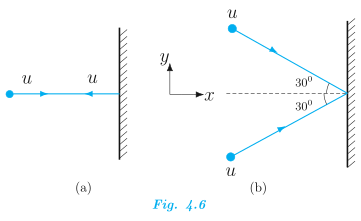
Q.Two identical billiard balls, each of mass , strike a rigid vertical wall with the same speed and rebound without any loss of speed, but they approach the wall along different directions. In the first case the ball travels horizontally and hits the wall head-on, its path being perpendicular to the wall (i.e. directed along the normal), and it rebounds straight back along the same line with speed . In the second case the ball approaches along a line that makes an angle of with the normal to the wall, and it rebounds along a line making with the normal on the other side, again with speed . Determine
You're viewing a preview — the full solution, concept, methods & PYQ mapping are locked.
Start your 14-day free trial to unlock the full solution →The key trick is to find the change in the ball's momentum, then use Newton's third law. In both collisions only the momentum component along the normal to the wall is reversed, so the impulse on the ball (and therefore the force on the wall) is normal to the wall in each case. The head-on ball reverses its whole momentum, the slanting ball reverses only the normal part, so the ratio of impulse magnitudes is .
Concept
The force during a collision cannot be found directly (the contact time is not given), but the impulse equals the change in momentum, . The force on the ball points in the direction of ; by Newton's third law the ball exerts an equal and opposite force on the wall. Choose the -axis along the inward normal to the wall (into the wall) and the -axis along the wall surface.
(i) Direction of the force on the wall
Case (a) — head-on strike: the ball moves along the normal. Its momentum before is (toward the wall) and after is (away from the wall):
The impulse on the ball is directed away from the wall (along ); by Newton's third law the force on the wall is along , i.e. normal to the wall.
Case (b) — strike at to the normal: resolve the velocity into a normal () and a tangential () component.
Only the normal component reverses; the tangential component is unchanged:
…
Unlock everything free for 14 days
- Full step-by-step solutions
- Concept-first explanations
- Methods, shortcuts & mistakes
- PYQ mapping + timed mock tests
Full access for 14 days. No credit card required.