Physics · Ch 9 — Mechanical Properties of Fluids
Surface Energy and Surface Tension
Surface Energy and Surface Tension
Surface Energy and Surface Tension
The molecules inside a liquid experience equal attractive forces from all directions, so the net force on them is zero. But a molecule at the surface has neighbours only on one side — the liquid side. On the other side is vapour (or air), where the molecular density is much lower. This imbalance pulls surface molecules inward, making the surface behave like a stretched elastic membrane. This is why a liquid surface always tries to minimise its area.
Two closely related quantities describe this behaviour: surface tension and surface energy.
Surface Energy
To increase the surface area of a liquid, you must bring molecules from the interior to the surface against the inward pull. This requires work. The work done per unit increase in surface area is stored as potential energy in the surface molecules. This stored energy is called surface energy.
The SI unit of surface energy is .
Surface Tension
Consider a liquid film stretched on a rectangular wire frame with one movable side of length . The film has two surfaces (top and bottom), so the total length of the film edge in contact with the movable side is . To keep the movable side from being pulled inward by the film, you must apply a force outward. This force is proportional to the length :
where is a constant characteristic of the liquid, called the surface tension.
In general, surface tension is defined as the force per unit length acting along the surface, perpendicular to any line drawn on the surface.
Surface tension is not a force that acts on a molecule. It is the force per unit length that the surface exerts on a boundary line (like the edge of a container or a wire). The direction of this force is tangential to the surface and perpendicular to the boundary line.
The SI unit of surface tension is .
Properties of Surface Tension
The textbook lists three key properties of surface tension. Each one follows directly from the molecular origin of the phenomenon.
Property (I): Surface tension is a property of the liquid surface as a whole, not of individual molecules. It arises from the net inward pull on surface molecules due to the imbalance of intermolecular forces.
Property (II): Surface tension depends only on the nature of the liquid and its temperature. It does not depend on the area of the surface. If you stretch a liquid film, the surface tension remains the same — you just have to do more work because you are creating more area against the same tension. …
Drawn by us to help you understand the concept clearly, and verified to make sure it's accurate. For exams, practice from your textbook's own diagram.
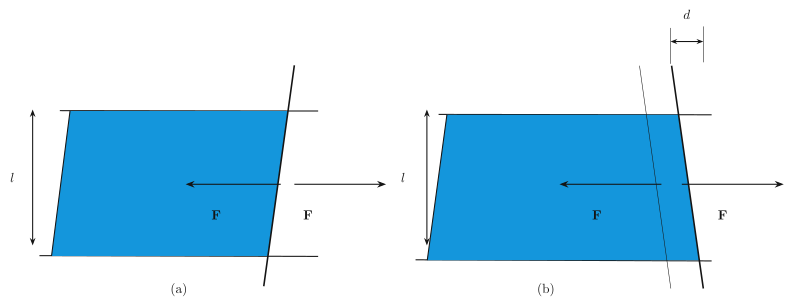
Fig. 9.15 is a simple but powerful diagram that shows you exactly what surface tension does when it acts on a liquid film. The figure has two panels, (a) and (b), both showing the same U-shaped wire frame with a thin liquid film stretched across it, like a soap film.
In panel (a), the film is in equilibrium. The frame has a fixed U-shape and a movable bar of length that slides along the two arms. The film pulls inward on this bar, trying to shrink its area. To keep the bar from moving, you must apply an equal and opposite force outward. The arrows in the diagram show these two forces — the film’s pull to the left and your applied force to the right — balancing each other exactly. The bar is stationary.
Panel (b) shows what happens when you stretch the film. You move the bar a small distance to the right, against the film’s inward pull. The force you apply is still present, but now the bar has been displaced. The film’s area has increased by an amount (the length of the bar times the distance it moved). The key idea is that the film resists this increase in area — it behaves as if it has an elastic skin.
The physical lesson is that a liquid surface behaves like a stretched membrane. It always tries to minimise its surface area. To increase the area, you must do work against this inward pull. That work is stored as surface energy.
The textbook uses this figure to derive the central formula for surface tension. The work done by the applied force in moving the bar a distance is:
But this work increases the film’s surface area. Notice that the film has two surfaces — a top and a bottom — so the total increase in area is . The surface tension is defined as the force per unit length acting along the surface, perpendicular to the bar. For the film, the total force due to surface tension on the bar is (because the film pulls on both sides of the bar). In equilibrium, this equals the applied force :
Substituting this into the work equation gives:
The quantity is precisely the increase in total surface area . Therefore, the work done per unit increase in area is:
Here, is the surface tension (in N/m), is the force applied to the movable bar (in N), is the length of the bar (in m), is the work done (in J), and is the increase in total surface area (in m²). The factor of 2 in the denominator of accounts for the two surfaces of the film. …
Drawn by us to help you understand the concept clearly, and verified to make sure it's accurate. For exams, practice from your textbook's own diagram.
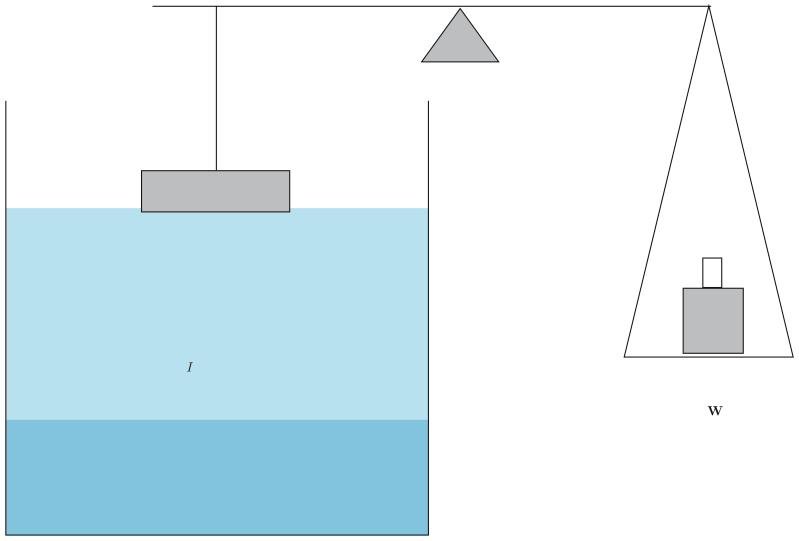
Fig. 9.16 is a schematic of a direct method for measuring surface tension. A thin, flat rectangular plate (labelled I) is suspended from one arm of a balance beam. The plate is brought into contact with the surface of a liquid in a vessel. On the other arm of the balance, a weight W is placed to balance the system when the plate just touches the liquid.
The key physical idea is this: when the plate is in contact with the liquid surface, the liquid wets it and pulls it downward due to surface tension. This downward force acts along the entire line of contact between the plate and the liquid. To measure it, you add weights to the other side until the plate just lifts off the surface. The extra weight needed (beyond the weight of the plate itself) equals the force of surface tension.
The figure shows the plate touching the liquid, the balance beam, the fulcrum, and the weight W. There are no axes or curves — it is a diagram of an apparatus, not a graph. The labels are: I (the plate), W (the balancing weight), and the fulcrum of the balance.
The textbook uses this figure to derive the formula for surface tension. The force due to surface tension acts along the perimeter of the plate in contact with the liquid. For a rectangular plate of length and breadth , the total length of contact is . However, if the plate is very thin (its thickness is negligible compared to its length), the breadth term can be ignored, and the effective length of contact is approximately (the two long edges). The surface tension is defined as force per unit length:
where is the extra force required to pull the plate away from the liquid surface (equal to the additional weight added to the other pan, after accounting for the plate's own weight), and is the length of the plate. The factor of 2 appears because the liquid contacts both the front and back faces of the plate.
A common mistake is to forget the factor of 2. The liquid wets both sides of the plate, so the total length of the contact line is twice the plate's length (for a thin plate). If the plate has significant thickness, you must use the full perimeter . …
| Liquid | Temp (°C) | Surface Tension (N/m) | Heat of vaporisation (kJ/mol) |
|---|---|---|---|
| Helium | −270 | 0.000239 | 0.115 |
| Oxygen | −183 | 0.0132 | 7.1 |
| Ethanol | 20 | 0.0227 | 40.6 |