Young’s Modulus: The Stretchiness of a Solid
When you pull on a rubber band, it stretches easily. When you pull on a steel rod of the same size, it barely moves. Both are elastic — they return to their original shape when you let go — but they resist stretching very differently. Young’s modulus is the number that tells you exactly how much a material resists being stretched or compressed lengthwise.
The Intuition: Stiffness per Unit Size
Think of a spring. A stiff spring requires a large force to stretch it a little. A soft spring stretches a lot with a small force. Young’s modulus is like the “stiffness” of a material, but it’s cleverly designed to be independent of the object’s shape and size.
If you take a thick steel rod and a thin steel wire of the same length, the rod is harder to stretch. That’s because you’re pulling on more material. Young’s modulus removes this size effect — it tells you the stiffness of the material itself, not the particular piece you’re holding.
The Precise Definition
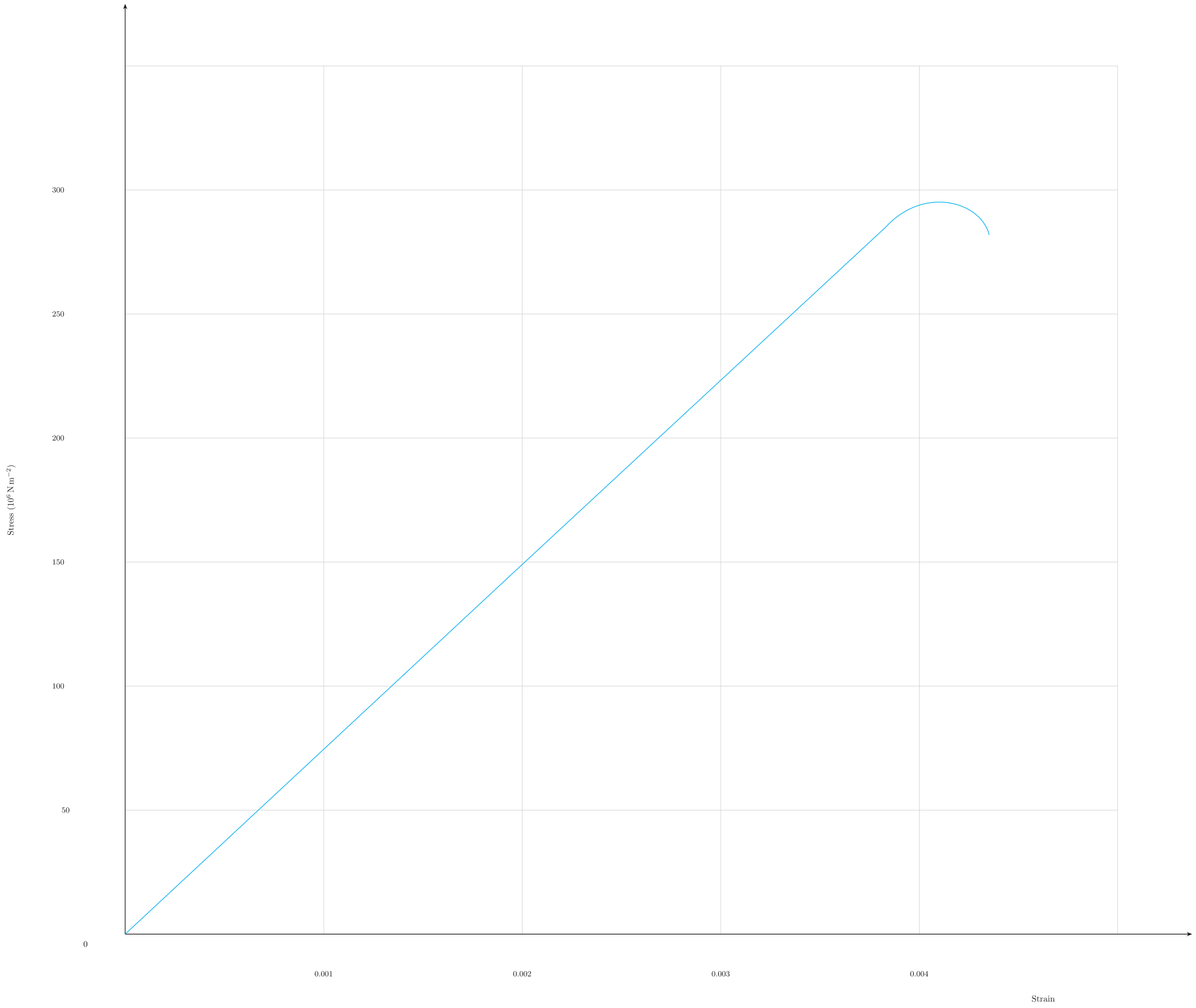
Young’s modulus (E or Y) is defined as the ratio of tensile stress to tensile strain, as long as the material obeys Hooke’s law (the deformation is reversible and proportional to the force).
Y=Tensile StrainTensile Stress
Let’s break down the two parts.
Tensile Stress (σ) is the force per unit area. If you pull with a force F on a rod of cross-sectional area A, the stress is:
σ=AF
Stress has units of pressure — pascals (Pa) or N/m2. It tells you how “intense” the pulling is, regardless of the rod’s thickness.
Tensile Strain (ε) is the fractional change in length. If the original length is L0 and it stretches by ΔL, the strain is:
ε=L0ΔL
Strain is a pure number — it has no units. A strain of 0.01 means the rod stretched by 1% of its original length.
Putting it together:
Y=ΔL/L0F/A=AΔLFL0
What the Number Tells You
A high Young’s modulus means the material is very stiff — it takes a huge stress to produce even a tiny strain. Steel has Y≈200×109 Pa. A low Young’s modulus means the material is easily stretched. Rubber has Y≈0.01×10⁹ Pa — about 20,000 times smaller than steel.
Young’s modulus is only valid in the elastic region — where the material returns to its original shape after the force is removed. If you stretch too far (past the elastic limit), the material deforms permanently or breaks, and Young’s modulus no longer applies.
A Worked Example
A steel wire of length 2.0 m and cross-sectional area 1.0×10⁻⁶ m2 is pulled by a force of 100 N. How much does it stretch? (Young’s modulus of steel = 2.0×10¹¹ Pa)
From Y=AΔLFL0, rearrange:
ΔL=AYFL0=(1.0×10−6)×(2.0×1011)100×2.0=2.0×105200=1.0×10⁻³ m=1.0 mm
The wire stretches by just 1 mm. If you tried the same with a rubber band of the same dimensions (Y≈107 Pa), the stretch would be about 20,000 times larger — 20 metres! (Of course, a real rubber band would break long before that.)
Key Points for Exams
- Young’s modulus is a material property — it doesn’t depend on the object’s length or thickness.
- It applies only to axial (lengthwise) tension or compression, not to bending or twisting.
- The units are the same as pressure: pascals (Pa) or N/m2.
- For most materials, Young’s modulus is the same in tension and compression (within the elastic limit).
Do not confuse Young’s modulus with stiffness (k=F/ΔL). Stiffness depends on the object’s dimensions (k=YA/L0). Young’s modulus is the intrinsic material property; stiffness is the property of a particular object.
"Youngs Modulus important questions" is a common search among CBSE and competitive-exam aspirants alike, since Youngs Modulus sits squarely within the Mechanical Properties of Solids coverage of NCERT Class 11 Physics, so it is fair game for both CBSE board questions and competitive-exam numericals. Pairing this explanation with NCERT Physics textbook practice and previous years' questions is the surest way to lock the concept in before an exam.