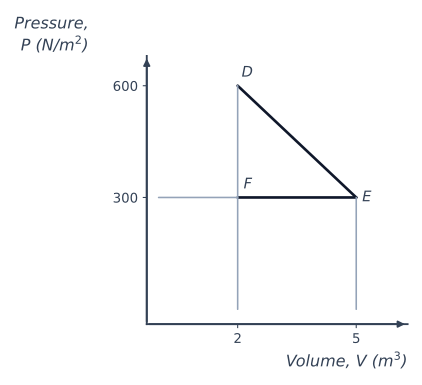
Q.A thermodynamic system is taken from an original state to an intermediate state by the linear process shown in Fig. 11.11. Its volume is then reduced to the original value from E to F by an isobaric process. Calculate the total work done by the gas from D to E to F.
You're viewing a preview — the full solution, concept, methods & PYQ mapping are locked.
Start your 14-day free trial to unlock the full solution →The work done by a gas in any quasi-static process is the area under its curve on a pressure-volume diagram, taken positive for expansion and negative for compression. Here the path has two legs: a straight-line expansion (a trapezoidal area of ) and a constant-pressure compression (a rectangular area of ). The two add to a net .
Concept
For a quasi-static process the work done by the gas is
which is geometrically the area between the process path and the volume axis. The sign follows the direction of volume change: expanding () gives positive work done by the gas; compressing () gives negative work.
Why this formula
Work is path-dependent, so we cannot use endpoint values alone — we must integrate along each actual leg. When varies linearly with (a straight line on the - plot), is simply the area of the trapezoid under that line, equal to the mean pressure times the volume change. When is constant, it is the area of a rectangle, .
Step 1 — Work along (linear expansion)
The pressure drops linearly from (at ) to (at ). The area under a straight line is the mean pressure times the volume change:
It is positive because the gas expands. …
Unlock everything free for 14 days
- Full step-by-step solutions
- Concept-first explanations
- Methods, shortcuts & mistakes
- PYQ mapping + timed mock tests
Full access for 14 days. No credit card required.